

Last Updated: November 17, 2026
Quick Summary
The best organic tampons for sensitive skin pair a cotton core with no added fragrance and a chlorine-free material story. Our top pick is The Honey Pot Company 100% Organic Cotton Multipack, while Veeda 100% Natural Cotton is the better value in bulk.
- Read labels closely: an organic seal covers the cotton core, not the string, cover, or applicator.
- Choose fragrance-free over unscented, since unscented products may still contain a masking fragrance.
- Select the lowest absorbency that handles your flow, and change tampons on a regular schedule.
- Stop using tampons and see a clinician if irritation comes with fever, foul odor, or worsening pain.
- Alternate with pads or period underwear on light days and overnight to give tissue a break.
Table of Contents
- Quick Comparison: Best Organic Tampons for Sensitive Skin
- What Makes a Tampon Gentle Enough for Sensitive Skin
- The Honey Pot Company 100% Organic Cotton Tampons: Multipack Pick
- Veeda 100% Natural Cotton Tampons: Best Value Bulk Option
- Why Fragrance-Free Tampons Matter for Sensitive Skin
- Tampon Irritation Symptoms: How to Tell What’s Wrong
- Tampon Absorbency and Fit: Choosing the Right Size
- Choosing Your Organic Tampons at EVE
- Frequently Asked Questions
Quick Comparison: Best Organic Tampons for Sensitive Skin
If you have reactive skin, finding the best organic tampons for sensitive skin comes down to three things: a cotton core without added fragrance, a chlorine-free material story, and an applicator that does not fight you on insertion. Many people tell us they have tried product after product labeled “gentle” and still ended up itchy, raw, or uncomfortable.
Below, we compare four options we carry, explain what actually makes a tampon gentle, and walk through absorbency, fit, and irritation signs worth watching. The short version: The Honey Pot Company’s 100% Organic Cotton Multipack is our top pick for most people, and Veeda’s 96-count box is the better value if regular absorbency already works for you.
| Product | Absorbency Options | Count | Applicator | Price | Best For |
|---|---|---|---|---|---|
| The Honey Pot Company Organic Cotton Multipack (Regular & Super) | Regular and Super in one box | 54 | BPA-free plastic | $23.64 | Most people, especially first-time organic buyers |
| The Honey Pot Company Organic Cotton (Regular only) | Regular | 54 | BPA-free plastic | $23.64 | Lighter flow days and steady regular users |
| The Honey Pot Company Organic Cotton (Super only) | Super | 54 | BPA-free plastic | $23.64 | Heavier days and overnight use |
| Veeda 100% Natural Cotton | Regular | 96 | Compact BPA-free plastic | $29.31 | Bulk buyers who know their size |
Count
What Makes a Tampon Gentle Enough for Sensitive Skin
A tampon is gentle when what touches your skin and vaginal tissue is simple: a cotton core, no added fragrance or deodorant, and a chlorine-free material story.
The vagina is a mucous membrane, not skin. If you want a deeper breakdown of what goes into period products and why it matters, our guide to period products without chemicals covers the ingredient side in more detail.
One honest limitation up front: “organic” and “hypoallergenic” are not interchangeable, and neither one is a medical guarantee.
What Labels and Certifications Actually Verify
A tampon is not one material. It is at least four: the absorbent core, the cover or overwrap, the withdrawal string, and the applicator. A certification on the front of the box usually applies to the cotton in the core, not automatically to the string, the cover, or the plastic barrel. That distinction matters more for sensitive users than any single badge.
Here is how to read the claims you will actually see:
- Certified organic cotton (for example, a USDA organic seal or a third-party cotton certification): verifies how the cotton was grown and handled, no synthetic pesticides in the growing process, and restrictions on processing. It does not verify the string, the cover, or the applicator.
- Chlorine-free: a processing claim about how the material is whitened. “Chlorine-free” usually means an alternative whitening method was used. It says nothing about fragrance or dyes.
- Fragrance-free vs. unscented: not the same thing on a label. “Unscented” can still mean a masking fragrance was added to smell like nothing. “Fragrance-free” is the stronger claim for reactive skin, but read the full ingredient panel, because the terms are not used identically across brands.
- Hypoallergenic: a marketing term, not a regulated standard. Treat it as a starting point, not a promise.
- BPA-free applicator: refers to the plastic housing only, not the tampon itself.
- Dermatologist-tested or gynecologist-tested: describes who evaluated the product, not what they found.
Materials to Look For and Materials to Avoid
Look for a cotton core, a fragrance-free and unscented label, and a chlorine-free claim stated plainly on the box. Avoid tampons with added deodorant, scented finishes, or vague “freshness” language, since those usually mean fragrance is present.
On the “avoid” side, the biggest practical issue for sensitive users is not a single scary chemical. It is fit and dryness. A tampon that is too absorbent for your flow pulls moisture from tissue that needs it, and that friction is a common cause of soreness. Match absorbency to flow first, then worry about materials.
A few terms worth knowing:
Watch out: a box can carry an organic cotton seal and still include a scented or synthetic component elsewhere in the product. If a single ingredient or material is your trigger, read the full panel and, when it is unclear, contact the brand directly.
The Honey Pot Company 100% Organic Cotton Tampons: Multipack Pick
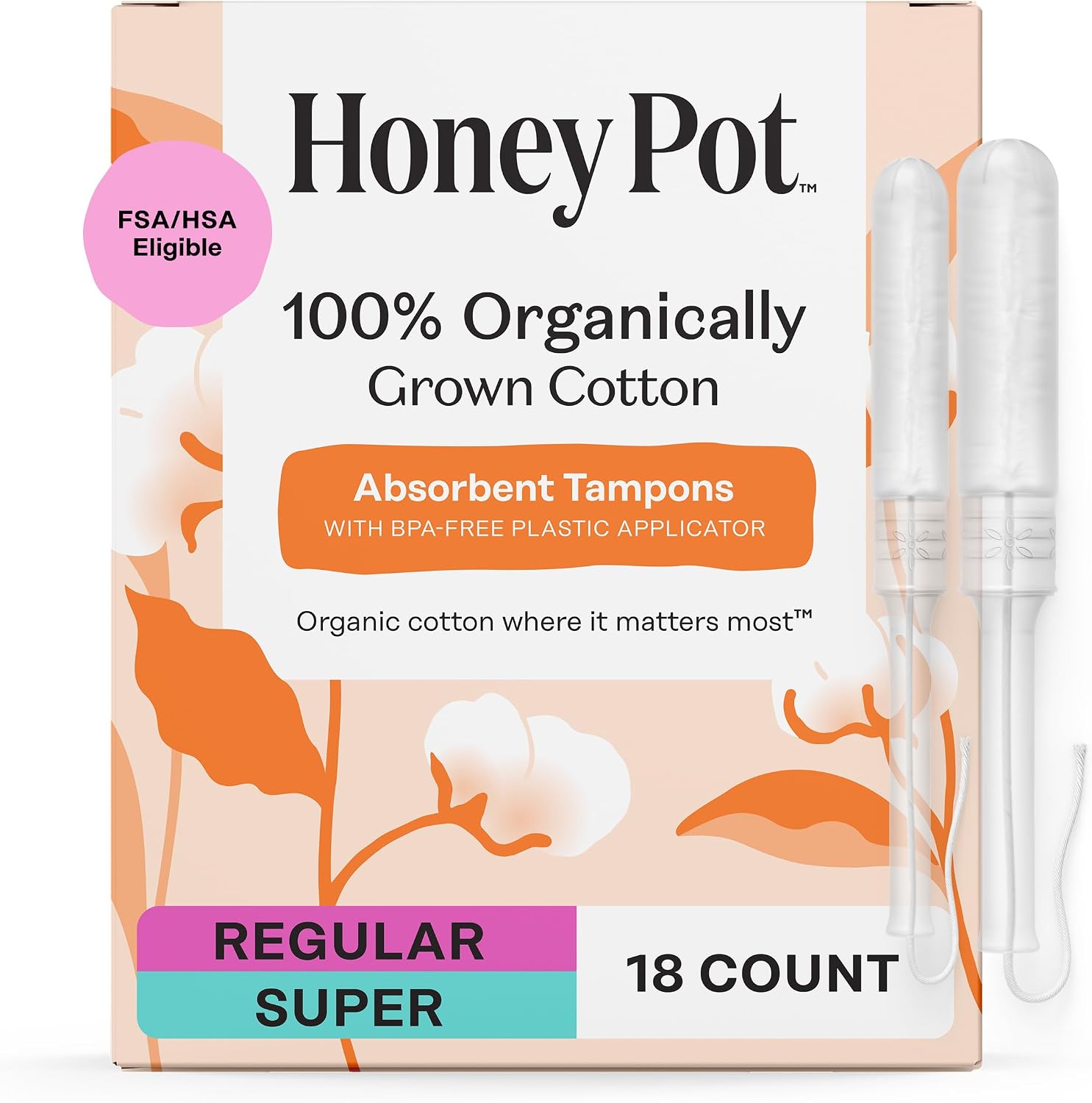
Our top pick for most people is The Honey Pot Company’s 100% Organic Cotton Tampons in the Regular & Super multipack.
Best for: anyone building a first organic tampon routine, or households where two people need different absorbencies.
Skip if: you only ever use one absorbency, since you would be paying for sizes you will not reach for.
The applicator is made of BPA-free plastic. If a low-waste routine matters more to you, an applicator-free option may suit you better.
If you want to see the full listing and pick your absorbency, you can view the organic cotton tampon multipack directly.
Veeda 100% Natural Cotton Tampons: Best Value Bulk Option
Veeda’s 100% Natural Cotton Tampons are the better per-tampon value if regular absorbency is your default. The 96-count box runs $29.31, uses a compact BPA-free applicator, and is listed as unscented, hypoallergenic, and free from chlorine.
The applicator is described as compact and BPA-free.
Best for: regular-flow users who want one box to last several cycles, and anyone who prefers a shorter applicator.
Skip if: your flow changes a lot through your period, because a single-absorbency box leaves you without a Super option on heavier days.
The honest limitation here is flexibility. Since a large box makes it harder to adjust when your needs change, choosing materials that feel comfortable against sensitive skin matters just as much in Men’s Big & Tall Clothing.
Why Fragrance-Free Tampons Matter for Sensitive Skin
Fragrance-free tampons remove one possible irritant from the equation for people with reactive skin.
Here is the part most guides get wrong: “unscented” and “fragrance-free” are not legally the same thing on a label. An unscented product may contain a fragrance designed to smell like nothing.
The FDA guidance on cosmetics and fragrance labeling is a useful reference for how fragrance is disclosed on personal care products, and the American College of Obstetricians and Gynecologists’ guidance on vulvovaginal health notes that scented products are a common irritant for the vulva. Neither is specific to tampons, but the principle carries over.
Tampon Irritation Symptoms: How to Tell What’s Wrong
Tampon irritation symptoms usually show up as itching, burning, redness, or a raw feeling around the vaginal opening, sometimes with increased discharge.
Watch out: if irritation comes with fever, a foul odor, or pain that gets worse rather than better after removing the tampon, stop using tampons and speak to a clinician.
For a broader look at what safe feminine care looks like for reactive skin, our guide to safe feminine care for sensitive skin walks through product categories and what to check on a label. General education only, of course.
Tampon Absorbency and Fit: Choosing the Right Size
Choose the lowest absorbency that handles your flow for the hours you need it, and change it on a regular schedule. That single rule prevents more irritation than any material upgrade, because a poorly sized tampon causes friction, dryness, and leakage all at once.
A practical way to size it:
- Regular: light to moderate flow, most daytime hours, and the right starting point if you are unsure
- Super: heavier days and overnight, not all-day wear
- Multipack: the safest first purchase if you have never tracked your flow by absorbency before
Safe-Use Basics for Sensitive Skin
Absorbency is also a safety issue, not just a comfort one. Tampon packaging is expected to include absorbency information and safe-use guidance. The practical takeaways for anyone with reactive tissue:
- Use the lowest absorbency that meets your flow, and step down as your period lightens.
- Change tampons regularly, and never leave one in longer than the package directs.
- Alternate with pads or liners on lighter days and overnight to give tissue a break.
- Wash your hands before and after insertion, and change the tampon if insertion is painful rather than pushing through.
Watch out: if insertion or removal is consistently painful, or you feel pressure or discomfort that builds during wear, that is a signal to size down or switch products, not to push through. Persistent pain is worth raising with a clinician.
When Pads or Other Products May Be the Better Choice
If your tissue is already irritated, raw, or healing, a tampon may not be the kindest option for a few days.
If you are still deciding between product types entirely, our comparison of pads, cups, and period underwear is worth reading before you commit to tampons at all. And if you want guidance on matching products to sensitive skin specifically, see our guide to reliable protection for sensitive skin.
The FDA’s consumer information on tampon safety and absorbency explains the absorbency labeling system and why lower absorbency is generally the safer choice.
Choosing Your Organic Tampons at EVE
If you are still not sure which box to start with, start with the multipack. It removes the guesswork about absorbency, it is fragrance-free and chlorine-free, and it costs the same as either single-absorbency box.
At EVE, we focus on feminine care products for everyday needs. Our catalog includes the tampon options described above, and our menstrual and ovulation tracking app is designed to help you learn about your cycle.
Explore EVE LLC to find products for your routine.
Frequently Asked Questions
Are organic cotton tampons better for sensitive skin?
Organic cotton tampons can be a gentler option because they skip synthetic fibers and often skip added fragrances and chlorine bleaching. That matters if your skin reacts to those materials. That said, organic cotton is not a guarantee against irritation. How you use a tampon, including absorbency choice and wear time, affects comfort just as much. If irritation keeps happening, talk with a healthcare professional to rule out other causes.
Can tampon ingredients or fragrances irritate sensitive skin?
Yes. Added fragrances and deodorizers are common triggers for vulvar irritation, and synthetic materials can feel abrasive to some people. Choosing fragrance-free tampons with a cotton core reduces your exposure to those triggers. Check the label for unscented and fragrance-free wording, since those terms are not always used the same way. If you notice burning or itching after switching products, stop using that product and speak with a clinician.
How can I tell whether a tampon is causing irritation?
Watch for itching, burning, redness, or discomfort that starts or worsens while you wear a tampon and eases after you remove it. Those are common tampon irritation symptoms. Keep track of which product, absorbency, and wear time you used so you can spot a pattern. If symptoms persist, worsen, or come with unusual discharge or odor, see a healthcare professional rather than guessing.
What should I look for in organic tampons for sensitive skin?
Look for a 100% organic cotton core, fragrance-free and unscented labeling, and chlorine-free processing. Check the applicator too: BPA-free plastic and compact designs can be easier to insert comfortably. Match absorbency to your flow and change tampons regularly. Our Honey Pot Company multipack and Veeda options both list organic or natural cotton, no added fragrance, and BPA-free applicators, so you can compare fit and price before committing.
Are fragrance-free tampons a good choice for sensitive skin?
For most people with sensitive skin, yes. Fragrance-free tampons remove one of the most common irritants in period care. They will not fix every comfort issue, but they are a sensible baseline. Pair them with the lowest absorbency that handles your flow and change them on schedule. If irritation continues with fragrance-free tampons, the cause may be something else, and a clinician can help you sort it out.






