
By EVE LLC Editorial Team
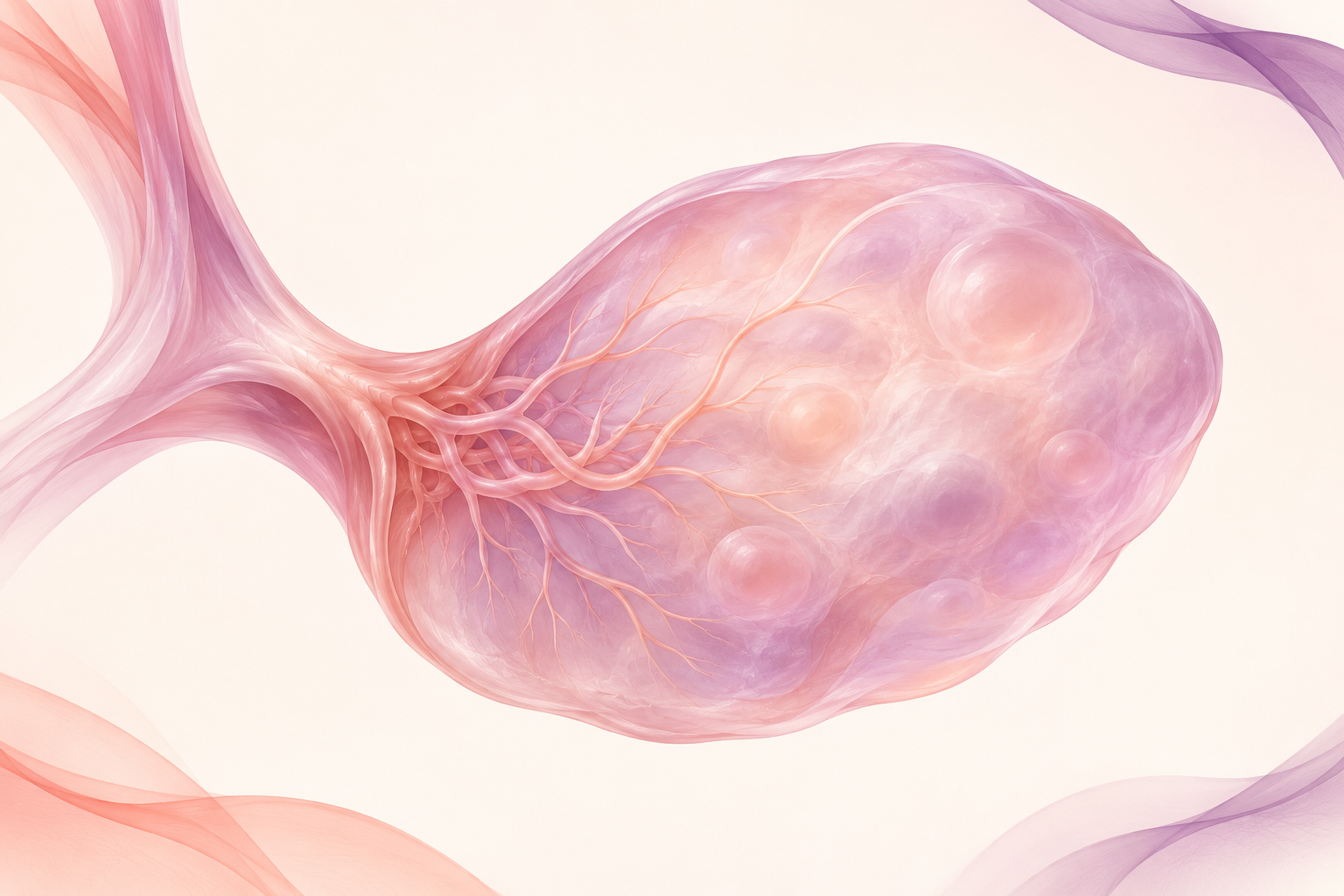
The rete ovarii is a small network of cords and tubules found in and near the ovary. It is not an ovarian follicle, an egg, or an ovarian cyst. Researchers have studied it for many years, but its full role in ovarian development and adult health is still being explored.
Where is the rete ovarii?
The rete ovarii is associated with the ovarian hilum, the area where blood vessels and nerves enter and leave the ovary. Researchers describe three connected regions: the intraovarian rete, within the ovary; the connecting rete; and the extraovarian rete, outside the ovary.
Although it is sometimes compared with the rete testis in the male reproductive system, that comparison describes a developmental relationship. It does not mean the two structures have identical functions. Research on the rete ovarii describes these regions and their development.
What does it do?
That remains an open research question. The rete ovarii has often been described as a leftover structure from development. A 2023 research preprint that has not been peer reviewed reported evidence in mice that parts of the rete ovarii develop into distinct regions, produce proteins, and move fluid toward the ovary. The findings suggest it may interact with ovarian tissue, but they do not establish what the rete ovarii does in adult humans.
A later review also notes that questions remain about its role in mature ovaries. More research is needed before scientists can say whether these findings have practical implications for human reproductive health. Read the review of current rete ovarii research.
Does “rete ovarii” mean something is wrong?
No. The name refers to an anatomical structure; seeing it mentioned in a medical or research context does not, by itself, mean someone has a disease.
Rare cysts and tumors arising from rete ovarii tissue have been described in medical literature. These reports concern uncommon findings, and a mention of the rete ovarii alone is not a cancer diagnosis. If the term appears in your pathology or imaging report, ask your clinician what the specific finding means in your case. See the published report on rare rete ovarii cysts and tumors and this case report of a rete ovarii cyst.
What should readers take away?
The rete ovarii is a small, easily overlooked structure connected to the ovary. New research is prompting scientists to look more closely at its possible functions, but much of what has been suggested comes from animal studies. Its role in human ovarian health is not yet fully understood.
For more background on reproductive health, read EVE’s guide to the phases of the menstrual cycle. If you have questions about a personal scan or pathology result, a qualified clinician can interpret it alongside your symptoms and medical history.
Sources
- Anbarci et al., “Rediscovering the Rete Ovarii” (preprint; not peer reviewed)
- “Revisiting the rete ovarii”
- “Cysts (cystadenomas) and tumors of the rete ovarii”
- “Cyst of rete ovarii: A case report”
Health note: This article is for general education and is not a diagnosis or a substitute for medical advice.





