
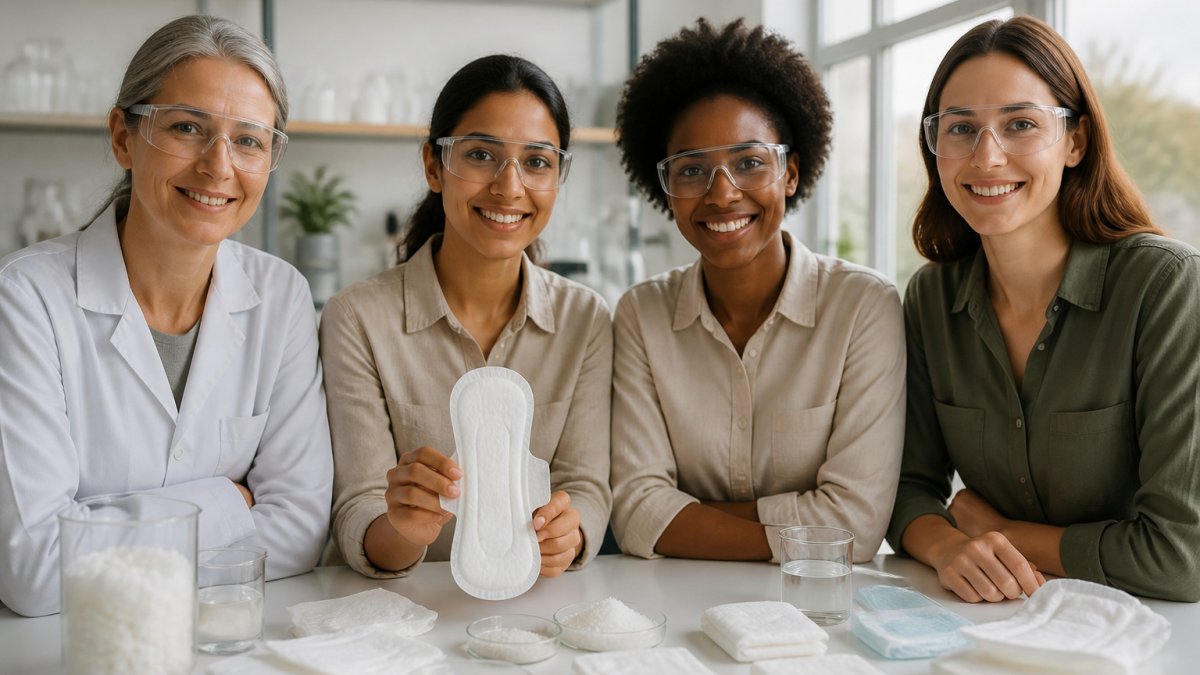
Quick Summary
Sanitary pads are made of layers: a skin-facing top sheet of nonwoven fabric or cotton, an absorbent core of wood pulp and super absorbent polymer, a leak-proof polyethylene backsheet, and adhesives that hold everything in place. Each layer has one job, and the materials determine how the pad feels, how much it holds, and how breathable it is.
- Most disposable top sheets use nonwoven polypropylene or polyethylene, though some pads use cotton instead.
- Super absorbent polymer is a gel-forming powder that locks liquid inside the core under pressure.
- Ultra-thin pads use a denser core with more SAP, while maxi pads lean on more pulp.
- Reusable cloth pads skip SAP and rely on layered cotton, bamboo, or hemp fabric instead.
- Check the top sheet, backsheet, SAP, and wrapper to account for most plastic in a pad.
Table of Contents
- The Layers of a Sanitary Pad, Explained
- Menstrual Pad Materials: A Glossary of What You’ll See on Labels
- Inside the Menstrual Pad Absorbent Core
- How Much Plastic in Menstrual Pads Is There?
- Hypoallergenic Menstrual Pads and Sensitive Skin
- How Pad Materials Change Across Types and Absorbencies
- Choosing Pads That Match Your Body and Values
- Frequently Asked Questions
The Layers of a Sanitary Pad, Explained
If you have ever wondered what are sanitary pads made of, the short answer is layers: a skin-facing top sheet, an absorbent core, a leak-proof backsheet, and adhesives that hold everything in place.
A sanitary pad is a layered absorbent product worn outside the body during menstruation, postpartum bleeding, or light incontinence.
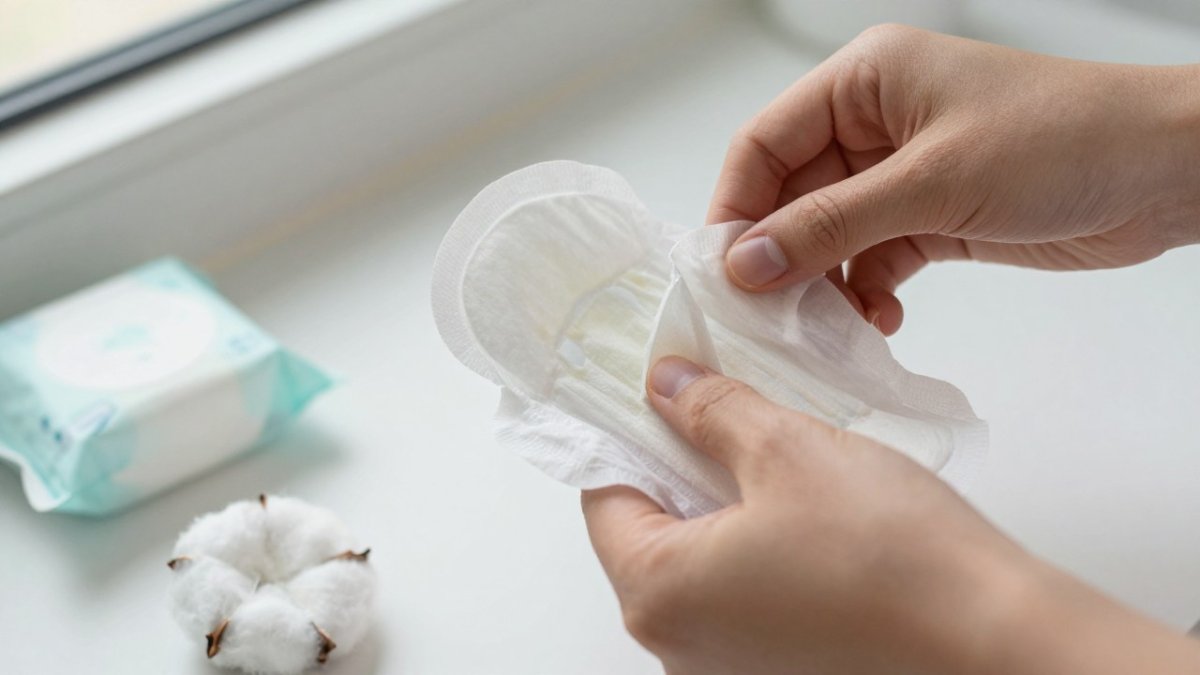
Top Sheet: What Touches Your Skin
The top sheet is the layer in direct contact with your skin. Most disposable pads use a nonwoven fabric made from synthetic polymers such as polypropylene or polyethylene, because these materials wick moisture away quickly and feel dry. Some pads use a cotton or organic cotton top layer instead, which many people with sensitive skin prefer. The U.S. Food and Drug Administration’s guidance on menstrual products treats pads as medical devices, which is why material disclosure matters.
Backsheet and Wrapper: The Leak-Proof Outer Layers
The backsheet is the moisture-proof layer that keeps blood from soaking through to your underwear. It is typically a thin film of polyethylene or a breathable polyolefin film, and the wings and adhesive strips attach here. The release liner covers the hot-melt adhesive until you peel it off, and the wrapper protects the pad before use. Together these are the main plastic layers in a disposable pad.
Menstrual Pad Materials: A Glossary of What You’ll See on Labels
Labels are written in chemistry, not plain English. This glossary translates the menstrual pad materials you are most likely to see so you can read a package with confidence.
- Nonwoven fabric: Engineered fabric bonded without weaving, used for top sheets and backsheets.
- Wood pulp / cellulose fiber: Plant-derived fluff pulp that forms the bulk of the absorbent core.
- Super absorbent polymer (SAP): A gel-forming powder that locks liquid inside the core.
- Polypropylene / polyethylene: Synthetic polymers used in nonwovens, films, and adhesives.
- Cotton flannel / bamboo fiber / hemp fiber: Plant-based materials used in reusable and organic pads.
- Release liner: The peel-off paper or film covering the adhesive.
Inside the Menstrual Pad Absorbent Core
The menstrual pad absorbent core is where the real work happens. It sits between the top sheet and the backsheet and is built from absorbent fibers and, in most disposable pads, a small amount of SAP. The core’s job is to pull menstrual fluid away from your skin fast and hold it there under pressure, and the way it does that is worth understanding because it explains why two pads of the same thickness can perform very differently.
Wood Pulp, Cellulose, and Super Absorbent Polymer
Most disposable cores combine wood pulp and cellulose fiber with super absorbent polymer. The pulp is a mat of short, fluffy cellulose fibers that spreads liquid sideways across the core through capillary action, so a small wet spot becomes a broad, thin one.
The two materials depend on each other. Pulp moves liquid quickly but holds relatively little under pressure; SAP holds a great deal but absorbs slowly if liquid cannot reach it. A well-built core layers them so the pulp distributes fluid into the SAP, and the SAP traps it.
A common pattern in core design is a three-part stack: an acquisition layer just under the top sheet that pulls fluid in fast, a distribution layer of pulp that spreads it, and a retention layer where SAP does the long-term holding.
Why Cores Are Built Differently by Absorbency
As absorbency rises, the core gets thicker and holds more pulp and SAP, and the backsheet often gets longer and wider for leak prevention.
Reusable cloth pads skip SAP entirely and rely on layered cotton, bamboo, or hemp fabric, which absorb through fiber bulk rather than gel.
How Much Plastic in Menstrual Pads Is There?
There is no single figure, because construction varies by brand and absorbency. What we can say is that most disposable pads contain plastic in several places at once: the synthetic nonwoven top sheet, the polyethylene backsheet, the adhesive, and often the wrapper. That is why the question of plastic in menstrual pads comes up so often, and why the more useful skill is learning to read a pad the way you would read a food label.
Reading a Pad Label for Plastic Content
Material lists on pad packaging tend to group ingredients under broad terms. When a brand wants you to know a component is plant-based, it usually says so directly, for example “plant-based backsheet” or “bio-based polyethylene.” Recognizing these materials as synthetic ingredients in products also makes it easier to compare pad labels with the familiar synthetic ingredients used in conventional soap.
A practical approach is to scan for four things: the top sheet material, the backsheet material, whether SAP is present, and whether the wrapper is plastic or paper. Those four items account for most of the plastic in a typical disposable pad. If a package lists only “absorbent core” without naming pulp or SAP, that is a signal the disclosure is thin, not that the materials are absent.
The Lifecycle View: Sourcing, Manufacturing, Use, and Disposal
Plastic content is only one part of the environmental picture. A pad’s impact runs across its whole lifecycle: the sourcing of wood pulp and cotton, the energy and water used in manufacturing nonwovens and SAP, the packaging and wrapper, the use phase, and finally disposal.
Pads marketed as biodegradable typically swap some synthetic components for plant-based ones. Read the full material list rather than the front of the pack, and treat certification claims as a starting point for questions rather than an answer.
A Neutral Comparison Across Pad Types
Each category makes a different trade-off, and none is universally better. Conventional disposable pads are thin, widely available, and need no care beyond disposal.
| Pad Type | Main Materials | Best For | Trade-off |
|---|---|---|---|
| Conventional disposable | Nonwoven top sheet, pulp + SAP core, polyethylene backsheet | Everyday flow, thin fit | More plastic per pad |
| Organic cotton | Cotton top sheet, pulp core | Sensitive skin | Often costs more; core may still be synthetic |
| Reusable fabric | Cotton flannel, bamboo, hemp | Lower daily waste | Washing and drying time and water use |
| Biodegradable | Plant-based core and backsheet | Reducing some plastic | Breakdown depends on conditions; availability varies |
If you want an organic option, the Pee Safe organic cotton biodegradable pads use a bamboo pulp and organic cotton build, and the L. ultra thin pads with an organic cotton top layer are made without synthetic pesticides and fragrances.


Hypoallergenic Menstrual Pads and Sensitive Skin
Hypoallergenic menstrual pads are made to reduce the chance of irritation, usually by leaving out fragrance and dyes and by using a softer or cotton top sheet. If your skin reacts easily, start with an unscented pad and check the ingredient list for fragrances, and change pads regularly to limit moisture against the skin. For a closer look at options, see our guide to the best hypoallergenic feminine care products, and if you want more detail on choosing safely, read safe feminine care for sensitive skin.
How Pad Materials Change Across Types and Absorbencies
A panty liner, a regular pad, and an overnight pad are not just different sizes. As absorbency rises, the core gets thicker and holds more pulp and SAP, and the backsheet often gets longer and wider for leak prevention. Ultra-thin pads use a denser core with more SAP to stay slim, while maxi-style pads lean on more pulp. Wings add adhesive coverage at the sides. The same logic applies to odor control features, which are usually added to the core rather than the top sheet.
Conventional, Organic, Reusable, and Biodegradable Pads
Each category makes a different trade-off. Conventional disposable pads are thin and widely available. Organic cotton pads swap the top sheet for a organic cotton layer. Reusable fabric pads are washed and reused, cutting waste but requiring care. Biodegradable pads use more biodegradable materials in the core and backsheet. If you want an organic option, the Pee Safe organic cotton biodegradable pads use a bamboo pulp and organic cotton build, and the L. ultra thin pads with an organic cotton top layer are made without synthetic pesticides and fragrances.
| Pad Type | Main Materials | Best For | Trade-off |
|---|---|---|---|
| Conventional disposable | Nonwoven top sheet, pulp + SAP core, polyethylene backsheet | Everyday flow, thin fit | More plastic per pad |
| Organic cotton | Cotton top sheet, pulp core | Sensitive skin | Often costs more |
| Reusable fabric | Cotton flannel, bamboo, hemp | Lower waste | Washing and drying time |
| Biodegradable | Plant-based core and backsheet | Reducing plastic | Availability varies |
Choosing Pads That Match Your Body and Values
Start with your skin, then your flow, then your values. To compare pads with cups and period underwear before deciding, see our guide to choosing the best period product. Our own Pee Safe quarterly pack pairs regular and overnight pads in one box, and the Honey Pot organic cotton cover pads use an organic cotton cover with a pulp core. For a breathable cotton option, try the U by Kotex cotton ultrathin pads.

Frequently Asked Questions
What materials are commonly used in sanitary pads?
Most sanitary pads combine a soft top sheet, an absorbent core, and a leak-proof backsheet. The top sheet is often a nonwoven fabric made from polypropylene or polyethylene, or a cotton cover. The core usually holds cellulose or wood pulp plus a super absorbent polymer to lock in liquid. The backsheet is a thin plastic film, and hot-melt adhesive keeps the pad in place. Organic and biodegradable options swap some synthetic layers for cotton, bamboo, or plant-based fibers, so reading the label tells you exactly which materials you are getting.
Are menstrual pads made with plastic?
Many disposable pads do contain plastic. The backsheet is typically a polyethylene or polypropylene film that blocks leaks, and the top sheet and wrapper are often synthetic nonwovens too. That is why some pads feel less breathable than others. If you want to reduce plastic in menstrual pads, look for products that list plant-based or biodegradable backsheets, cotton covers, and paper wrappers. Reusable cloth pads avoid disposable plastic entirely, though they need washing between uses.
What is the absorbent core of a menstrual pad made of?
The menstrual pad absorbent core is the layer that holds menstrual fluid away from your skin. It usually combines cellulose fibers, often from wood pulp, with a super absorbent polymer (SAP) that turns liquid into a gel and keeps it from squeezing back out. Some pads use cotton or bamboo pulp instead of wood pulp. Thinner ultra-thin pads rely more heavily on SAP, while thicker maxi pads use more pulp. The mix affects how much a pad holds and how dry it feels.
Which sanitary pad is chemical free?
No pad is entirely chemical free, since even cotton goes through processing. What you can look for is a pad made without added fragrance, dyes, or chlorine bleaching, and with an organic cotton or plant-based cover. Hypoallergenic menstrual pads are formulated to lower irritation risk, but the term is not tightly regulated, so check the ingredient list. If your skin reacts easily, patch-test a new brand and talk to a healthcare professional about persistent irritation.
Understanding what a pad is made of puts you in control of comfort, leaks, and waste. EVE is here to make that choice simpler with respectful education and products built around real needs. Explore our feminine care collection to find a pad that matches your skin and flow, and let our team help you choose with confidence.






