

Last Updated: November 4, 2026
Quick Summary
There is no single healthiest period product for everyone; the healthiest period product is the one made from materials your skin tolerates, rated for your actual flow, and changed on schedule. Fewer irritating ingredients, correct absorbency, frequent changes, and clean hands reduce risk more than any label claim.
- Change a pad every 3-4 hours, or sooner if it feels damp, to prevent odor, irritation, and leaks.
- Choose fragrance-free over unscented, since unscented products can still contain masking fragrance.
- Change tampons every 4-8 hours and use the lowest absorbency that handles your flow.
- If water, privacy, or laundry is limited, choose disposables as your primary product.
- If you soak through a high-absorbency product in under two hours, raise it with a clinician.
Table of Contents
- What “Healthiest” Actually Means for a Period Product
- How the Main Types Compare at a Glance
- Period Products for Sensitive Skin
- Best Period Products for Heavy Flow
- Menstrual Cup vs Tampon: Safety, Comfort, and Fit
- How Often to Change a Pad (and Every Other Product)
- Matching a Product to Your Medical Situation
- Find Your Fit With EVE
- Frequently Asked Questions
What “Healthiest” Actually Means for a Period Product
There is no single healthiest period product for everyone. The healthiest option matches your flow, skin, anatomy, and medical history, and you can change it often enough to stay comfortable and safe.
That framing matters because most shopping advice skips it. A cup is not automatically healthier than a pad, and organic cotton is not automatically safer than medical-grade silicone.
The Four Things That Decide It
Four factors separate a product that works for you from one that causes problems:
- Material contact. What sits against your skin or vaginal tissue, and whether it contains fragrance, dyes, or other known irritants.
- Absorbency match. A product rated far above your flow can dry out tissue; one rated below it leaks.
- Wear time and change frequency. Every product has a safe window, and exceeding it is where most problems start.
How the Main Types Compare at a Glance
The four main categories are pads, tampons, menstrual cups, and period underwear. Each handles menstrual blood differently: pads collect it externally, tampons and cups collect it internally, and period underwear absorbs it into built-in fabric layers. Panty liners sit alongside these as light backup rather than a primary product.
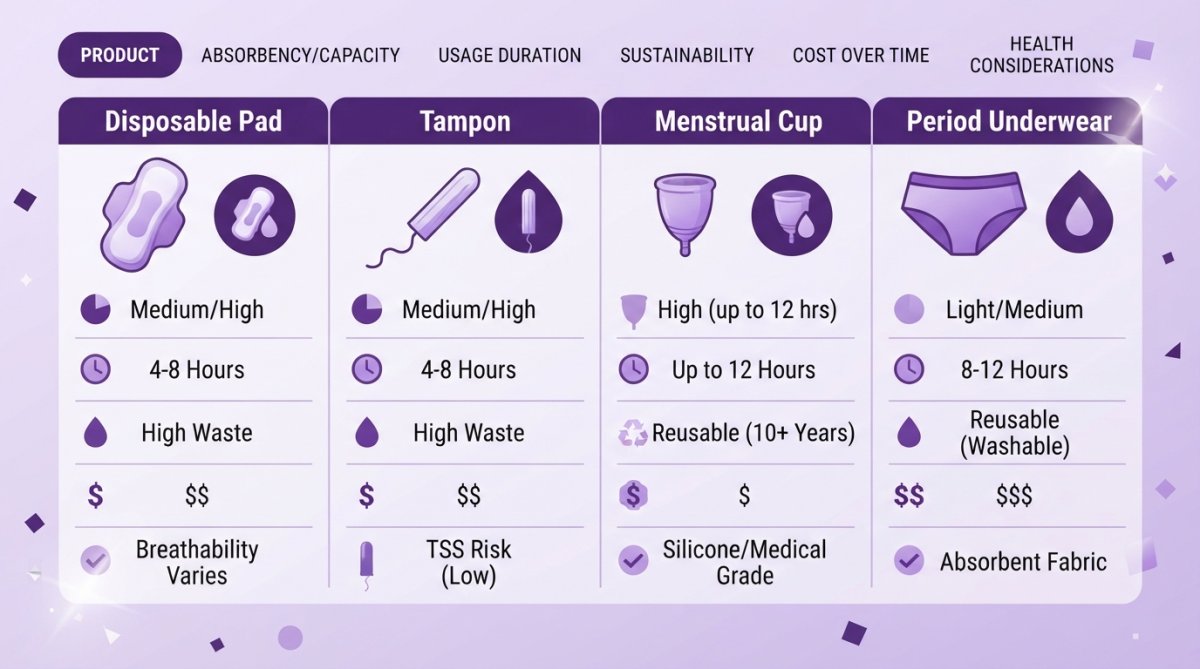
| Product | How It Works | Reusable? | Best For |
|---|---|---|---|
| Sanitary pads | External absorbent pad attached to underwear | No | Sensitivity, postpartum, overnight |
| Tampons | Internal cotton plug | No | Swimming, exercise, discretion |
| Menstrual cups | Internal silicone cup that collects blood | Yes | Long wear, lower waste |
| Period underwear | Absorbent fabric layers built into the garment | Usually yes | Backup, light days, overnight |
Two things stand out in that table. Cups and period underwear win on wear time and waste. Pads win on accessibility and on not requiring insertion. Tampons win on convenience during activity.
The U.S. Food and Drug Administration’s guidance on menstrual products treats pads, tampons, and cups as regulated medical devices, which is why material and labeling claims on the package are worth reading closely.
Period Products for Sensitive Skin
For sensitive skin, the healthiest period product is the one with the shortest ingredient list, no fragrance, and a top sheet your skin tolerates. Irritation from period products can be linked to fragrances, dyes, and synthetic top sheets. If you react to pads, start by switching to unscented, dye-free options before assuming you have a skin condition.
What “Clean” and “Non-Toxic” Actually Mean
Marketing terms like “clean,” “natural,” and “non-toxic” are not regulated safety standards. They are brand language, and they do not prove one product is safer than another.
- “Fragrance-free” over “unscented.” Unscented can still contain masking fragrance. Fragrance-free means no fragrance was added.
- A named material, not a mood word. “100% organic cotton top sheet” tells you something. “Pure” and “gentle” do not.
- No added dyes or deodorizers. These add nothing to absorbency and are common irritants.
Watch out: a longer ingredient list is not automatically worse, and a short one is not automatically safe. What matters is whether the ingredients that touch your skin are ones you have reacted to before.
What the Evidence on Chemicals Does and Does Not Show
You may have seen headlines about metals or other contaminants detected in tampons or pads. Studies that detect a substance establish that it is present; they do not on their own establish that the amount causes harm.
That does not make the concern meaningless, the honest position is uncertainty, not alarm and not dismissal. If you want to reduce exposure to anything you cannot identify, the practical levers are the same ones that help sensitive skin: fewer added fragrances and dyes, a known material against your skin, and changing products on schedule so contact time stays short.
Regulatory Oversight Differs by Product Type
Not every period product is regulated the same way, and that affects how much independent safety information exists. In the United States, the U.S. Food and Drug Administration’s guidance on menstrual products treats pads, tampons, and menstrual cups as regulated medical devices, which is why material and labeling claims on the package are worth reading closely. Period underwear is generally regulated differently from internal devices, so the safety evidence and labeling you can expect varies by category.
Matching Materials to Your Skin
If your skin reacts, work from the outside in:
- Pads and liners: a cotton or organic cotton top sheet with no fragrance and no added dyes is the lowest-irritation starting point. Pee Safe Comfort Ultra Thin Sanitary Pads are built around rash-free, cottony-soft wear. If organic cotton and biodegradability matter more, the Pee Safe 100% Organic Cotton Biodegradable Sanitary Pads use an organic cotton build for overnight protection.
- Liners for non-period days: a breathable liner helps more than a full pad. The Anandi Panty Liners use a certified 100% organic cotton top sheet and are designed for daily use on non-period days.
- Internal products: medical-grade silicone cups and cotton tampons avoid the fragrances and synthetic top sheets that cause most pad irritation, but insertion itself can irritate if you have vaginal sensitivity. Talk to a clinician if insertion is painful.
Watch out: switching to “natural” products does not fix irritation if you are changing too infrequently. A fragrance-free pad left on too long can still cause problems.
Best Period Products for Heavy Flow
Heavy flow needs absorbency plus a backup plan, not just a higher-rated pad. The healthiest approach is a high-absorbency product changed on schedule, paired with a second layer such as period underwear or a wider overnight pad.
For postpartum or travel days when you want full coverage without laundry, the Nua Comfort Period Panties come in a disposable pack of five, sized XL-XXL.
- Daytime: high-absorbency pad or tampon, changed every 3-4 hours.
- Overnight: overnight pad with a wider back, plus period underwear as backup.
- Out and about: carry a spare pad and a spare pair of underwear.
If you soak through a high-absorbency product in under two hours, or you bleed for more than seven days, that is worth raising with a clinician. The American College of Obstetricians and Gynecologists’ patient guidance on heavy menstrual bleeding explains what counts as heavy bleeding and when to seek evaluation.
Menstrual Cup vs Tampon: Safety, Comfort, and Fit
Cups and tampons both sit inside the vagina, but they carry different risk profiles.
- Use the lowest absorbency that handles your flow.
- Change tampons every 4-8 hours, and never leave one in overnight beyond the package guidance.
- Alternate with pads on lighter days.
Cups still require clean hands, a proper seal, and regular emptying. Many cups can be worn for several hours, which suits long shifts and overnight wear, depending on the model.
For a first cup, the Ezcup Reusable Menstrual Cup comes with a portable sterilizing container and is listed for up to 8-10 hours of use. If you want both sizes to find your fit, the EcoBlossom Reusable Menstrual Cup Set includes small and large medical-grade silicone cups rated for up to 12 hours.
Best for: readers who want longer wear and less waste.
Skip if: you are uncomfortable with insertion or have limited hand mobility.
How Often to Change a Pad (and Every Other Product)
Change a pad every 3-4 hours, or sooner if it feels damp. That is the single most useful habit for preventing odor, irritation, and leaks, and it applies whether your pad is cotton or synthetic. The same principle scales to every other product.
| Product | Overnight? |
|---|---|
| Sanitary pad | Yes, use an overnight pad |
| Panty liner | Not as primary protection |
| Tampon | Follow package guidance |
| Menstrual cup | Yes, if rated for it |
| Period underwear | Yes, per brand guidance |
Handwashing before and after every change is not optional. It is the cheapest infection-prevention step available, and it matters most with internal products.
Matching a Product to Your Medical Situation
The right product changes with your circumstances, and this is where generic advice fails. A product that suits a teenager with a light flow may be wrong for someone recovering from surgery. The goal is not the “best” product in the abstract but the one you can use correctly, consistently, and comfortably given your body and daily life.
Medical Circumstances That Change the Answer
- Postpartum: overnight pads and disposable period underwear are common first choices while bleeding is heavy and tissue is healing. Ask your clinician before using internal products.
- Post-surgical or limited mobility: pads and pull-on period underwear are easier to manage than cups. If reaching or gripping is difficult, look for pads with wider adhesive backs and underwear you can pull on without fine motor work.
- Endometriosis or PCOS/PMOS with heavy bleeding: high-absorbency products plus a backup layer, and a conversation with your clinician about the bleeding itself rather than only about managing it.
The Office on Women’s Health guidance on menstrual hygiene and product use is a useful plain-language reference to share with a clinician if you are unsure which category fits you.
The Practical Barriers Nobody Mentions
A product can be safe on paper and still be the wrong choice because of your circumstances. Four practical factors decide whether a reusable or internal option is workable, and they matter as much as material and absorbency:
- Access to clean water. Cups and period underwear need rinsing and washing. If clean water is unreliable where you change or live, a disposable pad may be the more hygienic choice, not the lesser one.
- A private place to change and clean. Cups require emptying, rinsing, and reinserting, which needs a sink and privacy. Shared bathrooms, school settings, and some workplaces make that hard. Pads and period underwear need far less.
- Laundry access. Period underwear has to be washed and dried between wears. Without reliable laundry, reusables become impractical no matter how good they are.
This is also where period poverty and the pink tax enter the conversation. The healthiest product for you is partly a question of what you can reliably access, and no product is healthy if you cannot change it when you need to.
A Simple Way to Decide
Start with the constraint that is hardest to change, then work outward:
- If water, privacy, or laundry is limited, choose disposables as your primary product and treat reusables as a backup only if you can clean them properly.
- If mobility or insertion is the barrier, choose pads or pull-on period underwear and skip internal products without guilt.
- If cost is the barrier, ask about free product programs before assuming you have to choose the cheapest option on the shelf.
- If a medical condition is driving heavy or irregular bleeding, pick a product that manages it safely today and raise the bleeding itself with a clinician.
Watch out: a product you cannot change on schedule because of your circumstances is not the healthier choice, even if it scores better on materials or waste.
Find Your Fit With EVE
No single product earns the “healthiest” title outright. The healthiest period product is the one built from materials your skin tolerates, rated for your actual flow, and changed on schedule.
If you are still narrowing it down, start with the factor that causes you the most trouble. Irritation points to fragrance-free cotton. Leaks point to absorbency and coverage. Long days point to a cup.
At EVE, we stock options across all four categories so you can test what fits your body rather than guess. Our range includes medical-grade silicone cups, organic cotton pads and liners, and disposable period underwear for heavy-flow and postpartum days, all shipped in discreet packaging. Explore the EVE collection and build a period kit around your flow, your skin, and your schedule.
Frequently Asked Questions
What is the safest period product?
No single product is safest for everyone. The main safety factors are wear time and hygiene. Tampons carry a small but serious toxic shock syndrome risk, so change them every 4 to 8 hours and use the lowest absorbency that works. Pads and period underwear should be changed when damp. Menstrual cups need emptying every 8 to 12 hours and cleaning between uses. Whichever you pick, wash your hands before and after, and stop using anything that causes irritation.
Are menstrual cups healthier than tampons?
Cups and tampons both collect menstrual blood internally, but they differ in material and wear time. Medical-grade silicone cups can stay in longer, up to 12 hours for some models, and are reused rather than thrown away. That lowers waste and cost over time. Tampons are simpler to insert and widely available. Neither is automatically healthier; comfort, fit, and how reliably you can change on schedule matter more than the category itself.
Which period products are best for sensitive skin?
Start with products that list their materials plainly. Organic cotton top sheets, fragrance-free pads, and medical-grade silicone cups reduce the number of ingredients touching your skin. Anandi organic cotton panty liners use a GOTS certified organic cotton top layer for non-period days. Change products promptly, avoid scented wipes, and patch-test anything new. If irritation persists or you notice a rash, talk to a healthcare professional rather than cycling through more products.
How often should you change a pad or tampon?
Change a pad every 3 to 4 hours during the day, or sooner on heavy days when it feels damp. Overnight pads are designed for longer wear while you sleep. Tampons should be changed every 4 to 8 hours and never left in longer than 8. Menstrual cups can stay in up to 12 hours depending on the model. If you regularly soak through a product faster than these windows, that is worth raising with a gynecologist.
What period products work best for heavy flow?
Higher-absorbency overnight pads, disposable period underwear, and larger-capacity cups handle heavy flow best. Nua Comfort Period Panties offer 360-degree coverage and are described for heavy flow, which makes them useful for overnight or postpartum use. Many people pair two products, such as a cup plus a liner, for backup. Track your heaviest days in a cycle app so you can plan ahead and know when to talk to a clinician about bleeding that soaks through protection hourly.






