

Last Updated: October 26, 2026
Quick Summary
Shipping privacy personal care requires checking retailer privacy policies, requesting discreet packaging with neutral sender names, and using secure payment methods. Protect both the physical package and your digital data by understanding what information retailers collect, how long they retain it, and whether they share it with third parties.
- Read the privacy policy’s three key sections: data collection, data retention, and third-party sharing practices.
- Request a neutral sender name on your shipping label instead of the retailer’s brand name before checkout.
- Use a separate email address for personal care purchases to minimize your digital trail across accounts.
- Ask retailers directly what sender name appears on labels and whether they print contents descriptions on packages.
- Pair discreet packaging with data protection by reviewing retention policies and opting out of marketing communications.
Table of Contents
- Why Shipping Privacy Matters for Personal Care Orders
- How to Check a Retailer’s Shipping Privacy Policy
- What Appears on a Shipping Label and How to Minimize Disclosure
- Requesting Discreet Packaging for Personal Care Products
- Understanding Shipping Notifications and Order Privacy
- Steps to Protect Your Personal Data During Checkout
- Getting Started with Private, Discreet Delivery
- Frequently Asked Questions
Why Shipping Privacy Matters for Personal Care Orders
When you order personal care products online, your shipping address, order contents, and payment details travel through multiple systems.
Many people feel anxious about ordering intimate items online.
Shipping privacy protects more than your embarrassment, it protects your health information.
Most retailers collect far more than they display on your shipping label.
The FTC’s guidance on consumer privacy and data security outlines what companies must protect.
How to Check a Retailer’s Shipping Privacy Policy
Your first step is reading the privacy policy. We know, it’s long and dense. But three sections matter most for shipping privacy.
Look for these three sections in any privacy policy:
- Data collection: What information does the company collect? Do they track your browsing, location, or device details beyond what’s needed for shipping?
- Data retention: How long do they keep your order history and personal information? Shorter is better. Many companies keep data far longer than necessary.
- Third-party sharing: Do they sell or share your data with other companies? Some retailers share customer lists with advertisers or data brokers.
Find the privacy policy link at the bottom of the retailer’s website, usually labeled “Privacy Policy” or “Privacy & Security,” and read it before you buy.
Red flags to watch for:
- Vague language like “we may share your data with partners” without specifics
- No mention of data retention timelines
- No option to opt out of data sharing
- Missing contact information for privacy questions
If the policy is unclear, contact the company directly.
The Privacy Rights Clearinghouse’s guide to reading privacy policies provides more detailed guidance on what to look for in company privacy statements.
What Appears on a Shipping Label and How to Minimize Disclosure
Your shipping label is the most visible part of your order. Anyone who handles the package, from the carrier’s sorting facility to the delivery driver to a neighbor, can read what’s printed on it.
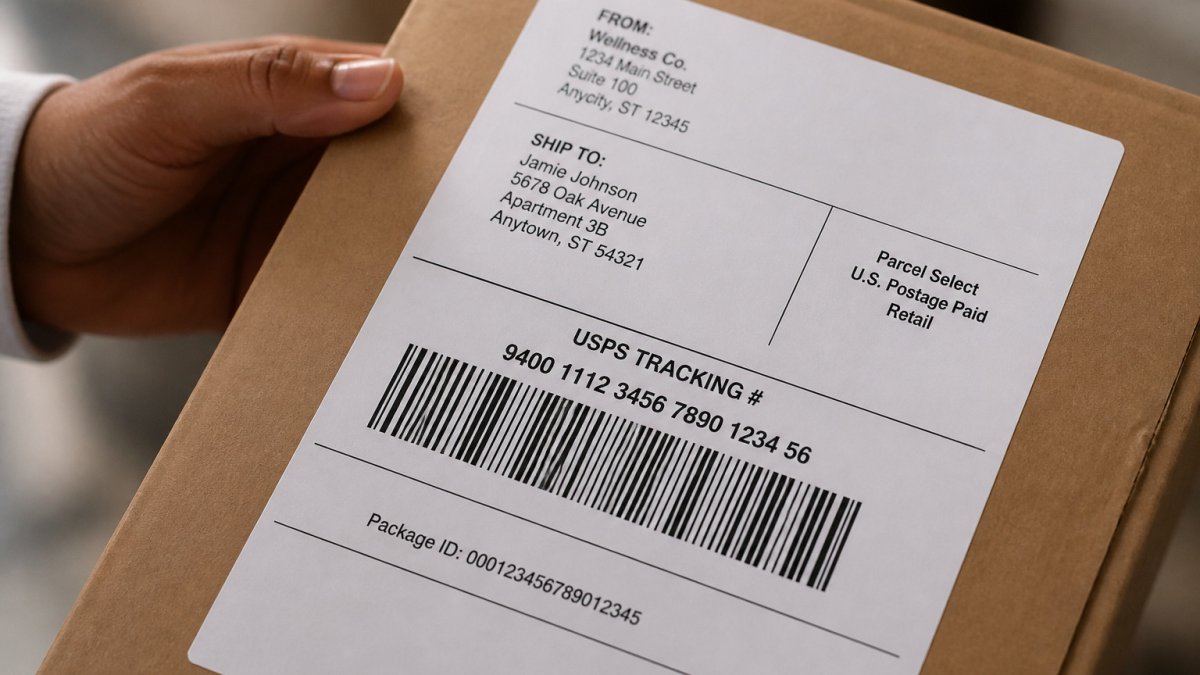
Standard shipping labels include:
- Recipient name and address. This is required for delivery. It is visible to the carrier, the driver, and anyone who sees the package at your door.
- Sender name and address. This is the retailer’s return address. If the retailer prints its full legal or brand name, the label announces what kind of store you ordered from.
- Tracking number and barcode. The barcode links to your order record in the carrier’s system. Carriers such as USPS, UPS, and FedEx use these codes to route and scan packages, and customer service staff can pull up order details from them.
- Service level and handling notes. Labels may show “Signature Required,” “Adult Signature Required,” or “Fragile.” These notes are visible to the driver and can draw attention to a package.
- Contents description. Some retailers print a short contents description, but many do not. When a description appears, it may reveal the product category.
The label isn’t the only record.
How to minimize what appears on your label:
- Ask for a neutral sender name. Many retailers will print a generic name such as “Wellness Supplies” or “Health Products” instead of the company name. Request this before checkout if the option is not automatic. A neutral sender name keeps the label from announcing the store category.
- Ask about the return label. Some retailers print full details on the return label as well. Ask whether they use a plain return label or whether you can request one.
- Avoid special handling notes when possible. If you do not need a signature, ask the retailer not to add “Signature Required” or similar notes. These notes are visible to the driver and can signal that a package is sensitive or valuable.
- Use a delivery instruction through the carrier. After purchase, some carriers let you add delivery instructions, such as leaving the package at a side door or with a building manager. These instructions are tied to the tracking record, not printed on the label, so they add privacy at the delivery point without changing what the label shows.
- Consider a pickup point. If you are concerned about a package sitting on your porch, ask the retailer or carrier whether the shipment can be held at a carrier location or pickup point. This removes the label from your doorstep.
Before you order, ask the retailer two direct questions: “What sender name will appear on the label?” and “Do you print any contents description on the outside?” Their answers tell you more than a general “discreet packaging” badge on the product page.
One limit: carriers require a deliverable address and a sender address on every label. You can’t remove those fields, but you can control how generic the sender name is, whether handling notes appear, and where the package is delivered. That’s where privacy is won or lost.
Requesting Discreet Packaging for Personal Care Products
Discreet packaging for shipping privacy personal care goes beyond hiding the company name. The entire package should look unremarkable: no brand logos, product names, contents description, or handling notes that signal what’s inside.
What discreet packaging can and cannot hide:
- It can hide the retailer’s brand name, the product category, and any contents description on the outside of the box.
- It can hide promotional inserts and branded tape that would otherwise identify the store.
- It cannot hide the recipient name and address, which are required for delivery.
- It cannot hide the sender address entirely, though a neutral sender name can replace the brand name.
- It cannot hide the carrier’s tracking record, which stores the sender name and recipient address digitally.
That distinction matters. Discreet packaging protects you from casual observers, neighbors, and anyone who sees the box at your door. It doesn’t erase the digital record held by the retailer and carrier.
How to request discreet packaging:
- Check the product and checkout pages first. Look for language such as “discreet packaging,” “plain packaging,” or “confidential delivery.” If the option is automatic, you may not need to do anything else.
- Contact customer service before you order. Email or call the retailer and be specific. A clear request works better than a vague one.
- Use a short, direct script. For example: “I would like my order shipped in plain packaging with no company branding, product names, or contents description visible on the outside of the box. Please also use a neutral sender name on the shipping label if possible.”
- Use the order notes field during checkout. Some retailers let you type a request directly into a “Special Instructions” or “Delivery Notes” field. Write the same request there so it travels with the order.
- Confirm after ordering. If you are unsure whether the request was applied, contact customer service again with your order number and ask them to confirm the packaging and sender name.
A pre-order checklist for verifying a seller’s privacy and shipping practices:
- Read the privacy policy and look for data collection, data retention, and third-party sharing sections.
- Look for a dedicated shipping or discreet packaging page on the retailer’s site.
- Check whether the retailer states what sender name appears on the label.
- Ask whether the retailer prints any contents description on the outside of the package.
- Ask how long the retailer keeps order history and whether you can request deletion.
Discreet packaging is a shipping-layer protection. Pair it with data-layer protections, such as a separate email address for personal care orders and a review of the retailer’s privacy policy, to cover the full path your order travels.
If you are ordering personal care products, ask the retailer about its packaging and privacy practices. Our policies are written in plain language.
Understanding Shipping Notifications and Order Privacy
Shipping notifications seem helpful. They tell you when your package arrives and where it is. But they also create a digital trail of your purchase.
What happens when you get a shipping notification:
The retailer emails you a tracking number that sits in your inbox; if someone gains access to your email account, they can see what you ordered and when.
Minimize the digital trail:
Use a separate email address for personal care purchases if you’re concerned about shared accounts or workplace monitoring. A separate inbox can help keep purchase details private, while discreet outer packaging is another part of protecting personal care orders, as reflected in INDOKRATOM.CA.
The Electronic Frontier Foundation’s tips on protecting your privacy during online shopping offers additional strategies for maintaining privacy throughout the entire purchase process.
Steps to Protect Your Personal Data During Checkout
Checkout is where most of your sensitive data gets collected.
Step 1: Use a secure payment method
Pay with a credit card rather than a debit card when possible. Credit cards offer better fraud protection.
Step 2: Review what data you’re sharing
Before you click “Place Order,” scroll through the checkout form.
Step 3: Check the company’s security
Look for “https://” in the URL bar and a small lock icon.
Step 4: Opt out of marketing communications
During checkout, you’ll usually see checkboxes for marketing emails or SMS messages.
Step 5: Save your privacy choices
If the retailer offers a privacy dashboard or account settings, log in after your purchase. Look for options to:
- Delete your order history after a certain period
- Opt out of data sharing
- Limit what information is stored in your profile
- Request that your data be deleted
The Consumer Reports guide to online shopping security provides detailed steps for protecting yourself throughout the entire online purchase process.
Getting Started with Private, Discreet Delivery
You deserve to shop for personal care products without worry. Privacy isn’t a luxury, it’s a basic right.
Start by choosing retailers that prioritize privacy. Read their privacy policies. Ask questions before you buy. Request discreet packaging. Use secure payment methods.
At Eve, we’ve built privacy into everything we do.
When you’re ready to order personal care products with confidence, discover how to buy women’s medical supplies discreetly online. And if you want a comprehensive approach to protecting your information throughout the entire shopping process, our complete guide to shopping medical products privately walks you through every step.
Your health information is yours alone. Shop with retailers who respect that.
Frequently Asked Questions
How can I tell whether an online order will arrive in discreet packaging?
Check the retailer’s shipping and privacy policy on their website before you order. Look for terms like ‘discreet packaging,’ ‘unmarked box,’ or ‘confidential delivery.’ Many retailers include this information in their FAQ or checkout options. If you don’t see it listed, contact customer service directly and ask about their packaging practices.
What information typically appears on a shipping label?
A shipping label includes your full name, address, phone number, the recipient’s address, and a tracking number. It may also show the shipper’s name and logo. The label itself doesn’t usually list product details, but the box’s external appearance or any visible branding might hint at contents. That’s why requesting unmarked or generic packaging is important for privacy, it keeps the box appearance neutral.
Do delivery notifications show the product name?
Delivery notifications from carriers typically show only tracking status and estimated arrival time, not product details. However, some retailers send their own order confirmation or shipping emails that may reference your items. Check your retailer’s privacy settings to control what information appears in notifications. You can often adjust email preferences to receive minimal details or opt for SMS-only updates.
What should I check in a retailer’s privacy and shipping policies?
Look for: data encryption during checkout, whether they share your information with third parties, their discreet packaging options, how long they keep your personal data, and their policy on refunds or returns. Verify they use secure payment methods and have a clear privacy statement. Eve’s insurance policies are written in plain language.
Privacy matters. At Eve, we make sure your personal care orders stay personal.






