

Last Updated: November 12, 2026
Quick Summary
To verify clean beauty ingredients, photograph the full INCI list, search each questionable ingredient by its INCI name, and cross-check two sources such as a safety database and a toxicology reference. Flag fragrance, essential oils, and preservatives if your skin is reactive, then patch test before full use.
- Clean is not a regulated term in the U.S., so any brand can print it on a label.
- Ingredients appear in descending order by weight down to one percent, then in any order.
- The full verification process takes about fifteen minutes per product.
- A skincare checker app is a useful first pass, not a final verdict on your skin.
- Natural does not mean gentle: essential oils and botanicals trigger reactions in many people.
Table of Contents
- Why Verifying Clean Beauty Ingredients Takes More Than a Label Claim
- How to Read Skincare Ingredient Labels Like an INCI List Pro
- How to Verify Clean Beauty Ingredients Online in 6 Steps
- Using a Skincare Ingredients Checker App Without Outsourcing Your Judgment
- How to Check Cosmetics Ingredients Safety Against Real Toxicology Data
- Natural vs. Synthetic, Comedogenic Ratings, and Your Own Skin Sensitivity
- Build Your Personal Clean Beauty Checklist Before Your Next Purchase
- Frequently Asked Questions
Why Verifying Clean Beauty Ingredients Takes More Than a Label Claim
Learning how to verify clean beauty ingredients starts with one hard truth: “clean” is not a regulated term. No U.S. agency defines it, approves it, or enforces it.
That is why the word alone tells you almost nothing. What matters is the ingredient list behind it, and whether you can read that list with confidence.
Below, we will show you exactly how to check a product before you buy it, from decoding an INCI list to using a skincare ingredients checker app without handing over your judgment.
The Greenwashing Trap: When ‘Clean’ Is Just Marketing
Greenwashing is when a brand makes a product sound safer or more natural than the evidence supports. It rarely involves an outright lie. More often it is a green leaf icon, a “free from” badge, and a nature photo doing the persuading.
Watch for these common moves:
- Vague claims like “toxin-free” or “chemical-free” (water is a chemical)
- Fear-based language that calls approved preservatives “dangerous”
- One hero ingredient featured on the front while the back label tells a different story
The fix is simple: ignore the front of the package. The back label is where the truth lives.
What ‘Clean’ Actually Means (and Doesn’t Mean) in the U.S.
In the United States, “clean beauty” is a marketing phrase, not a legal category. Cosmetics labeling and safety are overseen at the federal level, but no agency certifies products as “clean.” That work falls to independent bodies and to you.
What “clean” often signals in practice:
- No parabens, phthalates, sulfates, or formaldehyde releasers
- Fragrance-free or naturally scented formulas
- Fewer ingredients overall
What it does not guarantee: that a product is hypoallergenic, non-comedogenic, or right for your skin. Natural essential oils irritate plenty of people. “Clean” and “safe for you” are two different questions.
How to Read Skincare Ingredient Labels Like an INCI List Pro
The INCI list is the standardized ingredient naming system printed on the back of every cosmetic. Once you can read it, you can compare products in seconds.
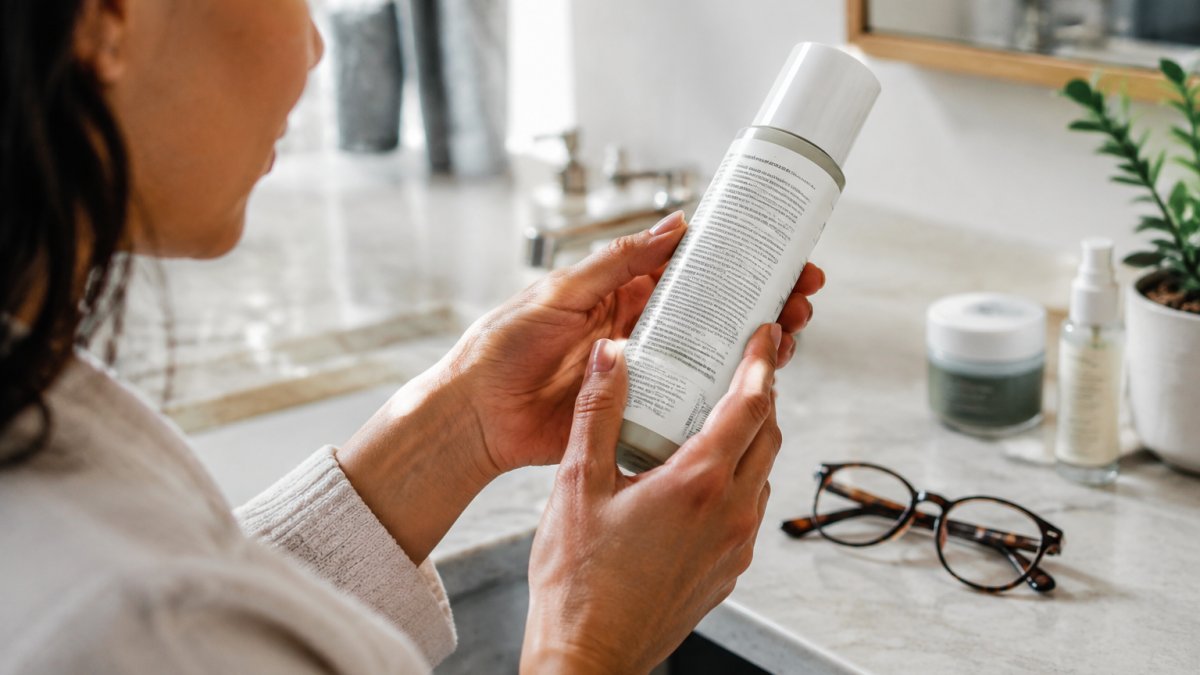
Here is how to work through one.
Ingredient Order, Concentration Levels, and What Comes After ‘Fragrance’
Ingredients appear in descending order by weight, down to one percent. After that, brands can list them in any order. That single rule changes how you read everything else.
- Top of the list means the highest concentration. If a “hero” botanical sits near the bottom, it is likely a trace amount.
- The one percent line is where concentration claims get fuzzy. Everything after it is a small share of the formula.
- “Fragrance” or “parfum” is a catch-all that can hide dozens of compounds, including fragrance allergens. If your skin reacts easily, treat it as a question mark.
A common mistake is assuming a shorter list is safer. You can put that skill to work on a real label by reviewing the Dot Key Barrier Repair Moisturizer, a fragrance-free, non-comedogenic formula with a full INCI list to read line by line.
How to Verify Clean Beauty Ingredients Online in 6 Steps
Verification is a repeatable process, not a vibe check. Use these six steps each time you shop a new product.
- Photograph the full ingredient list in the store or from the product page.
- Search each questionable ingredient by its INCI name, not its marketing nickname.
- Cross-check two sources: a safety database and a toxicology reference.
- Scan the barcode in a checker app for a second opinion.
- Flag fragrance, essential oils, and preservatives if your skin is reactive.
- Patch test before full use, every time.
| Step | What You Do | Time | Why It Matters |
|---|---|---|---|
| 1 | Photograph the INCI list | 1 min | Captures the real formula |
| 2 | Search INCI names | 5 min | Cuts through marketing names |
| 3 | Cross-check two sources | 5 min | Catches database gaps |
| 4 | Scan the barcode | 1 min | Fast second opinion |
| 5 | Flag known triggers | 2 min | Matches product to your skin |
| 6 | Patch test | 24-48 hrs | Confirms real-world tolerance |
The whole process takes about fifteen minutes. That is far less time than a return, a reaction, or another wasted purchase.
Time needed for each step of verifying clean beauty ingredients
Using a Skincare Ingredients Checker App Without Outsourcing Your Judgment
A skincare ingredients checker app is a useful first pass, not a final verdict. These tools scan a barcode or search an ingredient name and return a hazard score, often color-coded.
The Environmental Working Group’s Skin Deep database is one of the most widely used references and a reasonable starting point. The Cosmetic Ingredient Review publishes independent expert assessments you can read directly.
How Safety Scores Are Actually Built
Most checkers combine three inputs: hazard data on each ingredient, a weighting for concentration or product type, and a database entry that may or may not match the bottle in your hand. The output is a summary of one system’s judgment, not a measurement of your skin.
That produces predictable quirks:
- The same ingredient can score differently across databases because each weighs animal data, cancer classifications, and allergen listings differently.
- Concentration is often flattened. A preservative at 0.5% and a solvent at 40% may carry the same ingredient-level flag.
- Product type matters. A rinse-off cleanser and a leave-on cream expose skin very differently, and not every tool adjusts for that.
The Regulatory Limits Nobody Explains
Cosmetics are generally not pre-approved before they reach shelves, and fragrance disclosure is not standardized to show every component.
Two more limits matter for accuracy:
- Proprietary formulas. Some brands list ingredients under trade names or complex mixtures that databases cannot fully break down, so a checker may score a blend as a single entry.
- No global standardization. INCI naming is widely used, but labeling rules differ by market, so the same product sold in two places can carry different lists.
A hazard score is not a personal risk score.
We recommend using apps this way:
- Let the app flag ingredients to research, then read the actual entry rather than only the color
- Check whether the database formula matches the bottle’s current list
- Confirm anything concerning with a second source, such as a CIR assessment
Watch out: treating a green score as proof of safety can backfire, because a “clean” formula loaded with essential oils may still trigger a reaction in sensitive skin. Apps narrow the field.
How to Check Cosmetics Ingredients Safety Against Real Toxicology Data
Checking cosmetics ingredients safety means going one level deeper than scores. Toxicology data tells you how an ingredient behaves at given concentrations, by a given route of exposure, and that is the context a simple rating strips away.
Where to look:
- Peer-reviewed literature through PubMed for specific compounds, paying attention to study type and dose
- Official safety assessments from the Cosmetic Ingredient Review, an independent expert panel that publishes ingredient-specific reviews
- FDA cosmetic safety resources for regulatory context on labeling and prohibited ingredients
Reading Toxicology in Context
A study result means little without three details: the dose tested, the route of exposure, and whether the model was human skin, animal, or cell culture. A compound tested at industrial levels tells you little about a face cream. A useful question is not only “is this ingredient hazardous?” but also “at what concentration, in what product, on whose skin?”
That reframing is where most ingredient guides stop short. Two ideas do the heavy lifting:
- Hazard versus risk. Hazard is an ingredient’s intrinsic potential to cause harm. Risk is the likelihood of harm under real use. A formula can contain a hazard-flagged ingredient at a concentration that poses little risk, and a “clean” ingredient at a level that irritates.
- General safety versus personal sensitivity. An ingredient can be broadly safe and still be a sensitizer for you. Essential oils, some botanical extracts, and fragrance compounds are common examples: they are plant-derived and often marketed as clean, yet they trigger contact reactions in plenty of people. That is a sensitivity question, not a toxicity one.
A Worked Example of Label Scrutiny
Take a fragrance-free, paraben-free moisturizer like Cetaphil Moisturising Cream. The list is short enough to check line by line: identify each INCI name, note whether “fragrance” appears, and look up anything unfamiliar in a CIR review or PubMed before deciding.
Watch out: a “free from” claim on the front can distract from an essential oil or fragrance allergen further down the list, so read the full INCI line before trusting the badge.
Natural vs. Synthetic, Comedogenic Ratings, and Your Own Skin Sensitivity
Natural does not mean gentle, and synthetic does not mean harsh. Poison ivy is natural. Lab-made hyaluronic acid is synthetic and well tolerated by most skin. The natural-versus-synthetic split is the wrong question.
The better questions are:
- Is it comedogenic? Comedogenic ratings estimate how likely an ingredient is to clog pores. Coconut oil scores high; squalane scores low.
- Is it a known allergen? Fragrance allergens and some botanical extracts are common culprits.
- Does it suit your barrier? A compromised skin barrier reacts to more, so start simple.
Individual sensitivity beats general safety every time. If you are building a routine for reactive skin, our guide to the 7 best personal care products for sensitive skin is a practical next read.
Build Your Personal Clean Beauty Checklist Before Your Next Purchase
Your checklist should be yours, not a generic list from a blog. Build it once, then reuse it for every purchase.
- Full INCI list captured and readable
- “Fragrance” or “parfum” noted (yes or no)
- Known triggers checked against your reaction history
For a product that puts verification on the label, you can see how third-party review works on a formula like Areoveda Natural Prebiotic Intimate Wash, which carries EWG Verified status.
Verifying clean beauty ingredients takes a little practice, and then it becomes second nature.
Frequently Asked Questions
Are clean beauty products regulated or defined by one standard?
No. There is no standard definition of ‘clean beauty,’ and no agency certifies or approves cosmetics labeled clean. The term is set by brands, retailers, and third-party programs, so it can mean very different things from one label to the next. That is why verifying clean beauty ingredients yourself matters: check the actual INCI list, look for independent verification such as EWG Verified, and treat ‘clean’ as a starting point rather than proof of safety.
How accurate are skincare ingredient checker apps?
A skincare ingredients checker app is only as good as its database and scoring model. Some apps pull from published safety assessments and label ingredients clearly; others use a single aggregate hazard score that ignores concentration levels and how a product is actually used. Accuracy drops when a product is new, when the formula has changed, or when the app relies on user-submitted photos. Use these tools to flag ingredients worth researching, then confirm against the label and a source like the EWG Skin Deep database or the FDA’s cosmetic ingredient resources.
What should I look for on a cosmetic ingredient label to avoid irritation?
Start with the INCI list and note where fragrance and preservatives appear. ‘Fragrance’ or ‘parfum’ can hide dozens of fragrance allergens, so fragrance-free formulas are often a safer bet for reactive skin. Watch for known irritants such as methylisothiazolinone (MIT), SLS and SLES, and drying alcohol near the top of the list. Check comedogenic ratings if you are acne-prone. Patch test any new product on your inner forearm for a few days, and stop if you notice redness, stinging, or breakouts.
How can I verify a clean beauty claim on a product label?
Treat each claim separately. ‘Vegan’ and ‘cruelty-free’ describe sourcing and testing, not safety. ‘Hypoallergenic’ is largely unregulated and does not guarantee a reaction-free experience. ‘Non-toxic’ has no legal definition. To verify, scan the barcode with an ingredients checker app, read the full INCI list on the packaging rather than the front label, and look for third-party seals like EWG Verified, which reviews formulas against published health criteria. If a brand will not publish a full ingredient list, that is a red flag worth taking seriously.






