

Last Updated: November 22, 2026
Quick Summary
A period symptom tracker is a tool, on paper or in an app, for recording what you feel and observe across your menstrual cycle so patterns become visible over time. It logs daily details, surfaces patterns across months, and helps you plan ahead, but it does not diagnose anything.
- Log your period start and end dates, flow intensity, and any spotting between periods.
- Use a 1-to-3 severity scale plus one impact note to show whether a symptom mattered.
- Keep entries short: date, flow, two or three symptoms, and one mood word.
- Build a one-page summary of cycle basics, disruptive symptoms, timing, and impact before an appointment.
- Flag period pain that regularly stops you from working, studying, or sleeping.
Table of Contents
- What a Period Symptom Tracker Actually Does for You
- What to Track in a Menstrual Cycle: The Core Categories
- Building a Period Symptom Diary You Will Actually Keep
- Rating Symptom Severity and Impact, Not Just Presence
- Free Period Symptom Tracker Printable and Spreadsheet Options
- Using a Period Symptom Tracker PDF on Paper or On the Go
- Turning Your Log into a Record for a Healthcare Appointment
- Start Tracking with EVE and Know Your Cycle Better
- Frequently Asked Questions
What a Period Symptom Tracker Actually Does for You
A period symptom tracker is a tool, on paper or in an app, for recording what you feel and observe across your menstrual cycle so patterns become visible over time.
That gap matters. Your cycle history is the raw material for better period prediction, and for conversations with a clinician when something feels off.
A tracker does three jobs. It logs daily details without judgment. It surfaces patterns across months. And it helps you plan ahead, whether that means packing supplies or clearing a lighter day during heavy bleeding.
What it does not do is diagnose anything. A tracker is a period symptom diary, not a doctor.
What to Track in a Menstrual Cycle: The Core Categories
The most useful period symptom tracker covers more than cramps and a start date. Think of your log as having two layers: the cycle facts that anchor everything (dates, flow, spotting) and the symptom categories that give those facts meaning. Start with the facts for the first month, then layer in symptoms as the habit settles.
Cycle dates, flow, and spotting
Log your period start date and period end date. Note flow intensity on a simple scale, from light to heavy, and mark any spotting between periods. Over a few months, this builds an accurate picture of your cycle length and regularity. If you want to see how a calendar turns those dates into predictions, this guide on how to use a period tracking calendar walks through it.
A practical flow scale many people use: light (you could stretch a product change to six or more hours), moderate (roughly every four to six hours), heavy (every one to three hours, or waking at night to change), and spotting (a few drops, no full pad or tampon needed). Pairing a word with an estimate of how often you changed protection makes the entry more useful later than a word alone.
A categorized symptom checklist
Use this as a menu, not a to-do list. You do not need to log every line every day. Pick the categories that apply to you and note the two or three symptoms that stand out. Over a few cycles, the recurring entries are the ones worth discussing.
Physical and pain symptoms
- Cramps (dull, sharp, one-sided, radiating to the back or thighs)
- Headache or migraine
- Backache
- Breast tenderness or swelling
- Bloating and water retention
- Joint or muscle aches
- Acne flare-ups
- Fatigue or low energy
- Dizziness or lightheadedness
Digestive symptoms
- Nausea
- Constipation
- Diarrhea
- Appetite changes or specific cravings
- Heartburn or indigestion
Emotional and mood symptoms
- Irritability
- Anxiety or tension
- Low mood or tearfulness
- Mood swings
- Feeling overwhelmed
- Calm or elevated mood (worth logging too, so the picture is balanced)
Sleep symptoms
- Trouble falling asleep
- Waking during the night
- Vivid dreams
- Needing more sleep than usual
- Feeling unrested after a full night
Cognitive symptoms
- Brain fog or trouble concentrating
- Forgetfulness
- Word-finding difficulty
- Decision fatigue
Cycle-linked events worth a note
- Ovulation signs such as cervical mucus changes or one-sided twinges
- Spotting between periods
- Symptoms that appear at the same cycle day each month
Physical symptoms, pain, and mood in practice
Record cramps, headaches, backache, bloating, breast tenderness, and fatigue. Add mood changes and emotional symptoms alongside them. The point is not to rate yourself.
A common pattern is that physical symptoms cluster in the days before bleeding starts, while digestive and sleep changes show up earlier.
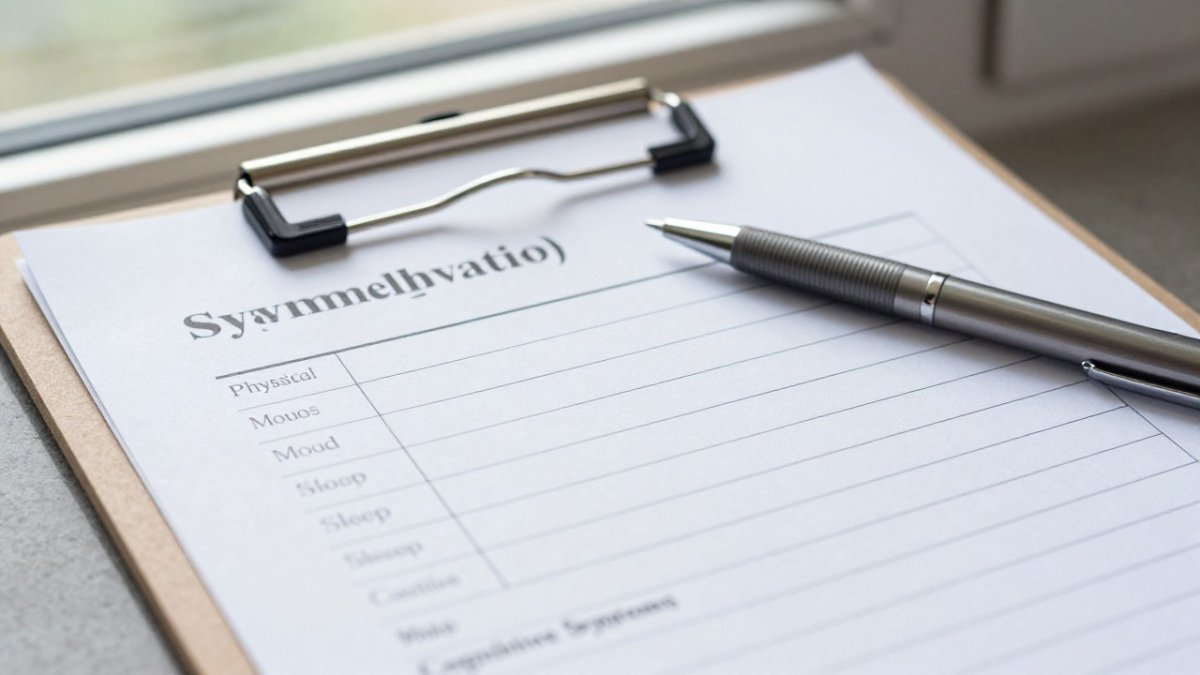
Building a Period Symptom Diary You Will Actually Keep
Most tracking habits die in week three. The fix is to make logging take under a minute and attach it to something you already do, like brushing your teeth or your evening wind-down.
Keep the entry short: date, flow, two or three symptoms, one mood word. Skip perfection. A missed day is not a failed month.
If you want a fuller routine to build around, our walkthrough on how to track your menstrual cycle effectively covers the habit from the ground up.
Rating Symptom Severity and Impact, Not Just Presence
A checkmark tells you a symptom happened. A rating tells you whether it mattered. Use a simple 1-to-3 scale for severity, then add one impact note.
- 1 (mild): noticeable, no change to your day
- 2 (moderate): distracting, some tasks harder
- 3 (severe): disrupts work, sleep, or plans
Impact is the detail clinicians find most useful. “Cramps, level 3, missed a morning of work” says more than “cramps.” If your period pain regularly lands at level 3, it is worth raising with a healthcare professional.
The article recommends a simple 1-to-3 severity scale paired with a short impact note.
| Rating | What it means | Example note |
|---|---|---|
| 1 (mild) | Noticeable, no change to your day | Cramps, level 1 |
| 2 (moderate) | Distracting, some tasks harder | Cramps, level 2, harder to focus |
| 3 (severe) | Disrupts work, sleep, or plans | Cramps, level 3, missed a morning of work |
Free Period Symptom Tracker Printable and Spreadsheet Options
Paper and spreadsheets remain the most flexible period symptom tracker printable formats, and both cost nothing to start. A printable works well if you like writing by hand.
Build either with the same columns: date, cycle day, flow, symptoms, severity, mood, notes.
A tracker you fill in but never read is just paperwork, so set a reminder at the end of each cycle to look back at the month.
Using a Period Symptom Tracker PDF on Paper or On the Go
A period symptom tracker PDF gives you the best of both: a clean layout you can print, and a file you can open on your phone when you are away from home.
The trade-off is manual entry. You will not get automatic cycle prediction from a PDF. What you get is full control over your health data, stored wherever you choose. For anyone who prefers not to keep cycle details in an app, that privacy is the point.
Turning Your Log into a Record for a Healthcare Appointment
Bring your log to the appointment. A few months of dated entries gives a clinician far more to work with than a verbal summary, especially for questions about cycle regularity, heavy bleeding, or period pain. But a raw log can be hard to read in a ten-minute visit. The skill is condensing it into a one-page summary the clinician can scan.
Build a one-page summary before you go
Pull four things from your log and write them on a single page:
- Cycle basics. Your average cycle length (first day of one period to the first day of the next), the shortest and longest cycle in your log, and how many days your period typically lasts.
- Your most disruptive symptoms. List the top three to five, each with a severity rating and how many days per cycle they last.
- Timing. Note where in the cycle each symptom appears, using cycle day or a phase label (for example, “cramps start cycle day 26, period starts day 28”). Understanding the phases of the menstrual cycle helps you describe when in your cycle each symptom appears.
- Impact. One line per symptom on how it affected work, sleep, exercise, or plans. “Missed two mornings of work” or “woke three nights” carries more weight than a severity number alone.
Use severity, frequency, and duration together
A single rating is easy to misread. Pair each symptom with three details: how bad it gets (your 1-to-3 scale), how many days it lasts, and how often it recurs across cycles. “Cramps, level 3, four days, every cycle for six months” tells a clinician something a checkmark never will. If a symptom is new, note the cycle it first appeared. If it changed, note when.
What to flag for the conversation
Some patterns are worth raising directly rather than waiting to be asked. These are general prompts, not a diagnosis:
- Period pain that regularly stops you from working, studying, or sleeping, or that does not ease with over-the-counter options
- Bleeding that soaks through protection every one to two hours, or clots larger than about a quarter
- Bleeding that lasts longer than seven days (value is what Coveo indexes and uses as the title in Search Results.–> <title>Abnormal…)
- Cycles shorter than 21 days or longer than 35 days, or cycles that have become noticeably irregular
- Spotting between periods or bleeding after sex
- Symptoms that have worsened over recent cycles
If any of these apply, a qualified healthcare professional is the right person to assess them. A tracker can show the pattern; it cannot explain the cause.
Mention the gaps
Watch out: a tracker records what you notice, not everything that happens. Missing entries can make a pattern look cleaner than it is, so tell your clinician which weeks you logged lightly or skipped. A short note like “logged consistently for three months, missed about a week mid-cycle” keeps the record honest and helps the clinician weigh it correctly.
Keep the summary for next time
Save your one-page summary with the date. At the next visit, you can compare it side by side and show whether a symptom improved, worsened, or held steady. That comparison is often more useful than any single cycle’s log.
Start Tracking with EVE and Know Your Cycle Better
The best period symptom tracker is the one you will actually use, whether that is a printed page, a spreadsheet, or an app on your phone.
EVE’s menstrual and ovulation tracking app is designed to support that habit. Learn more about how EVE works.
Tracking only pays off when you review it, and most people stop before patterns have a chance to form.
Frequently Asked Questions
What should I track in a period symptom tracker?
Start with the basics: period start and end dates, flow intensity, and any spotting. Then add physical symptoms like cramps, headaches, bloating, and breast tenderness, plus mood changes and energy levels. Note sleep, digestion, and anything that affects your day. A period symptom tracker works best when you log the same handful of items every day rather than trying to capture everything. Keep it to a few minutes per entry so the habit sticks across cycles.
Can I use a period symptom tracker printable instead of an app?
Yes. A period symptom tracker printable gives you a paper record you can keep in a drawer or bag, and it works without a phone or account. Print a fresh sheet each cycle with columns for date, flow, pain, mood, and notes. Paper suits people who want to stay offline or share a physical copy at an appointment. The trade-off is that you have to total and compare months yourself, while an app can chart patterns for you.
How many cycles should I track before looking for patterns?
Give it at least three cycles before you draw conclusions. One month can be thrown off by travel, illness, stress, or a missed entry, so a single cycle rarely shows a reliable pattern. Three to six cycles of consistent logging give you enough cycle history to see whether symptoms repeat at the same point, such as cramps on day one or mood shifts a few days before your period. Bring that record to a clinician if something concerns you.
When should I show my symptom record to a healthcare professional?
Talk to a clinician if your period pain stops you from working or studying, if bleeding soaks through protection quickly or lasts longer than usual for you, or if symptoms keep worsening across cycles. A written period symptom diary helps because it shows timing, severity, and how symptoms affect your days rather than a vague memory. This article is general education, not diagnosis, so raise personal concerns with a qualified healthcare professional.






