

Last Updated: November 14, 2026
Quick Summary
A period tracking calendar records your period start dates and uses your own cycle history to estimate when your next period will arrive. Mark day one of full flow, count the days until your next period begins, and repeat each month to build a pattern you can plan around.
- Day one is the first day of full flow, not spotting, so mark it clearly.
- Add up your last three to six cycle lengths and divide for your average.
- After three cycles you have a pattern; after six you have something to plan around.
- Track the range, not just the average, when your cycles vary widely.
- Start with start date, end date, and flow level, then add one field each cycle.
Table of Contents
- How a Period Tracking Calendar Predicts Your Next Period
- A Step-by-Step Guide to Manual Cycle Tracking
- Using a Period Calendar Template for Start and End Dates
- Choosing a Menstrual Cycle Tracker Online or on Paper
- Your First Period Tracker: Getting Started Without Pressure
- Using a Period Symptoms Tracker to Spot Patterns
- How Accurate Are Period Predictions, and When Should You See a Doctor?
- Start Your Period Tracking Calendar with EVE
- Frequently Asked Questions
How a Period Tracking Calendar Predicts Your Next Period
A period tracking calendar is a simple record of your period start dates that uses your own cycle history to estimate when your next period will arrive.
Your cycle starts on the first day of bleeding. Count the days until your next period begins, and you have your cycle length. Track a few cycles, and the math gets more useful.
Counting From Day One of Your Last Period
Day one is the first day of full flow, not spotting. Mark it clearly.
From there, count forward to the day before your next period starts. That number is your cycle length for that month.
The Office on Women’s Health guide to menstrual cycles notes that cycle length varies from person to person and from month to month. That variation is normal, and your calendar should capture it rather than hide it.
Why Cycle Length Matters More Than the 28-Day Rule
The 28-day cycle is an average, not a rule. Many people run shorter or longer, and their calendars should reflect that. If you assume 28 days and you actually run 32, every prediction will be wrong by four days.
Track your real average instead. Add up your last three to six cycle lengths, then divide by the number of cycles. That figure becomes your working cycle length, and you adjust it as new data comes in.
A Step-by-Step Guide to Manual Cycle Tracking
Manual tracking takes about two minutes a day and needs only a calendar and a pen. It is also the best way to understand what an app is doing when it predicts your next period. Here is the process we recommend, with a worked example.
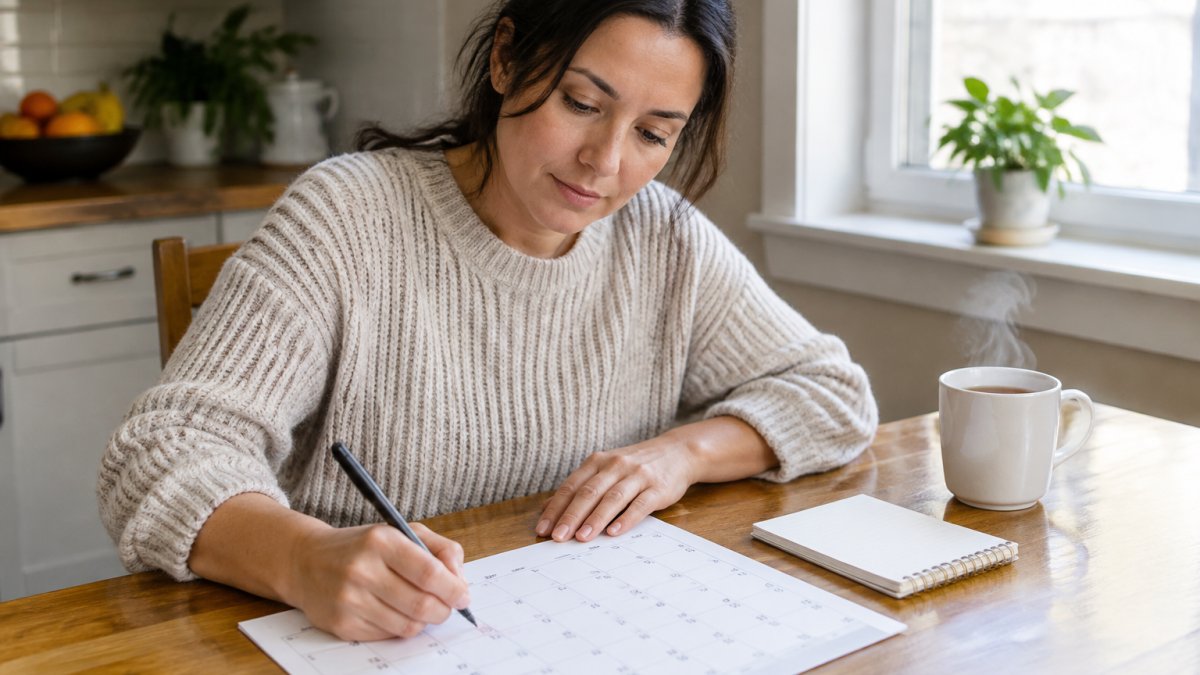
- Pick one calendar and use it every month. Paper or digital, but only one. Splitting records across a wall calendar and a phone note is the fastest way to lose a cycle length.
- Mark day one of your period with a clear symbol, such as a filled circle. Day one is the first day of full flow, not spotting.
- Mark the last day of bleeding with a different symbol, such as an open circle.
- Note the total number of bleeding days in the margin.
- Count the days from the start of one period to the day before the next period starts. That number is your cycle length.
- Write that cycle length in the margin next to the start date.
- Repeat each month and compare. After three cycles you have a pattern; after six you have something you can plan around.
A Worked Example
Say your period started March 3 and the next one started March 31. Count from March 3 up to March 30, that is 28 days, so March was a 28-day cycle. If the following period started April 30, that cycle ran 30 days. Your two-cycle average is 29 days, so your next expected start date is roughly 29 days after April 30.
Keep the raw numbers visible rather than only the average. When a prediction misses, the raw history tells you whether you were early, late, or working from a short sample.
What to Record Each Day
Beyond start and end dates, a few daily notes turn a plain calendar into a real period tracking calendar.
- Flow level: light, medium, or heavy
- Any spotting between periods
- Cramps and where you feel them
If you want to add temperature data, a basal body thermometer gives you a daily reading to log alongside these notes. Our Mabis digital basal body thermometer stores your last reading and beeps at peak temperature, which makes it easy to record each morning before you get out of bed.
Tracking Irregular or Changing Cycles
Not every cycle follows a fixed schedule, and a manual calendar handles variability well, as long as you record it honestly instead of forcing it into a 28-day shape.
- Log every start date, even the inconvenient ones. Skipping an odd cycle to “clean up” your average makes every future prediction worse.
- Track the range, not just the average. If your last six cycles ran 26, 34, 29, 41, 27, and 31 days, your average is about 31 days, but your realistic window is much wider. Write both down.
- Note what changed. Travel, illness, a new workout routine, significant stress, or a change in contraception can all shift timing. A one-line note beside the date explains an outlier later.
Low-Tech and Accessible Options
A period tracking calendar does not require a smartphone. Paper wall calendars, pocket diaries, printed monthly grids, and simple spreadsheets all work, and each has trade-offs worth knowing.
- Paper is private by default, needs no account, and never runs out of battery. The trade-off is that you do the counting and the math yourself.
- A spreadsheet can calculate cycle length and averages while staying on your own device, a good middle ground for people who want the math handled but prefer not to use an app.
- Large-print calendars, high-contrast markers, and voice notes can make tracking easier for people with low vision, arthritis, or fatigue. A tracking habit only helps if the format fits your hands and your routine.
Whichever format you choose, the principle is the same: one record, kept consistently, with the raw dates visible so you can see the pattern for yourself.
Using a Period Calendar Template for Start and End Dates
A period calendar template is a pre-built grid where you fill in start and end dates and let the layout show the gaps. You can draw one yourself in a notebook, print a blank monthly grid, or use a spreadsheet.
The template should have:
| Column | What to Enter | Why It Helps |
|---|---|---|
| Period start date | First day of full flow | Anchors every prediction |
| Period end date | Last day of bleeding | Shows period duration |
| Cycle length | Days between start dates | Builds your average |
| Symptoms | Short daily notes | Reveals patterns |
| Notes | Travel, illness, stress | Explains odd months |
Fill in the start and end dates first. Everything else is optional but useful.
Choosing a Menstrual Cycle Tracker Online or on Paper
Paper and digital trackers each have a place, and the right choice depends on how you live.
Paper suits people who want a physical record, no notifications, and no account. It is private by default because nothing leaves your home.
A menstrual cycle tracker online does the counting for you.
At EVE, our app is built as a menstrual and ovulation tracking tool, with education and community alongside it.
Your First Period Tracker: Getting Started Without Pressure
A first period tracker does not need to be perfect, and it does not need every feature. Start with three things: start date, end date, and flow level.
Skip the symptom logs for the first month if they feel like too much. Add one new field each cycle.
Watch out: the most common mistake is starting mid-cycle and guessing at your last start date.
Using a Period Symptoms Tracker to Spot Patterns
A period symptoms tracker turns scattered complaints into a visible pattern. When cramps follow a predictable pattern, planning ahead for menstrual cramp relief can make those days easier to manage.
Our Rekindle hormonal balance supplement is formulated for menstrual cramps, PMS, and cycle regularity, and a ThermaCare menstrual heating pad offers drug-free heat for up to eight hours. For cramps, bloating, and irritability together, a Pamprin multi-symptom caplet covers several symptoms at once.
How Accurate Are Period Predictions, and When Should You See a Doctor?
Period predictions are estimates, not guarantees. A calendar predicts based on past patterns, so it is most accurate when your cycles are regular and least accurate when they are not. Understanding why accuracy moves is more useful than any single predicted date.
Why Accuracy Varies
A prediction is only as good as the pattern behind it. Three things drive how close a forecast lands.
- How regular your cycles are. If your last six cycles all ran within a day or two of each other, a prediction has a narrow target. If they ranged from 26 to 41 days, any single date is a guess inside a wide window.
- How much history you have. One or two cycles is a thin sample. Three to six cycles give a more stable average, and the estimate keeps improving as you add data.
- What is happening in your life. Travel across time zones, changes in sleep, illness, significant stress, a new exercise load, and changes in contraception can all shift timing. A calendar cannot see those causes, so it keeps predicting from the old pattern until you log the new one.
Reading a Prediction as a Window, Not a Date
A more honest way to use a period tracking calendar is to treat the forecast as a range.
Write the window on your calendar next to the predicted date. It changes how you plan: you pack supplies a few days earlier, you do not treat a one-day miss as a problem, and you stop expecting a body to behave like clockwork.
Where Predictions Are Least Reliable
Accuracy drops in predictable places, and knowing them helps you set expectations.
- Puberty and the first few years of cycles, when timing is often irregular.
- After pregnancy and during breastfeeding, when cycles may pause or return unevenly.
- In perimenopause, when cycle length can swing widely before periods stop.
In these situations, tracking is still valuable, it documents the pattern you can bring to a clinician, but treat predictions as rough guides rather than planning certainties.
When Cycle Changes May Warrant Medical Advice
Tracking gives you something concrete to describe. Talk with a healthcare professional if:
- Your periods stop for several months without pregnancy.
- Bleeding lasts longer than a week.
- You soak through protection quickly or need to change it hourly.
The CDC guidance on uterine health and bleeding and the ACOG patient resources on abnormal bleeding both outline what warrants a conversation with a clinician.
If you want to confirm ovulation rather than guess from dates alone, ovulation test strips can help. Our Easy@Home ovulation test kit includes ten LH strips and pairs with an app for tracking. Used alongside a calendar, they add a second signal to compare against your predicted window.
Start Your Period Tracking Calendar with EVE
Tracking your cycle is one of the simplest health habits you can build, and it gets more useful with every month you keep at it.
At EVE, we make menstrual care products and a menstrual and ovulation tracking app that work together.
Get started with EVE and turn a few marked dates into a calendar you actually understand.
Your next period is coming whether or not you wrote it down.
Frequently Asked Questions
How do you use a period tracking calendar?
Mark the first day of your last period as Day 1, then count forward to the day before your next period starts to get your cycle length. A period tracking calendar shows your period start and end dates, and after a few cycles you can estimate your next period and fertile window. Log symptoms, flow, and mood changes daily so patterns become visible over time.
Do I count 28 days from the start or end of my period?
Count from the first day of your period, not the last. Day 1 is the first day of full flow, and your cycle length is the number of days until the day before your next period begins. The 28-day figure is only an average; many people have cycles between 21 and 35 days, so track your own pattern rather than forcing a 28-day count.
Can a period tracking calendar help me notice cycle patterns?
Yes. Logging period dates, flow, and symptoms in a period symptoms tracker reveals recurring patterns such as PMS timing, mood changes, and cycle length shifts. Over three to six months you can see whether your cycles are regular and flag changes worth discussing with a healthcare professional.
When should I talk to a healthcare professional about my cycle?
See a doctor if your periods suddenly become very heavy, last longer than seven days, occur more often than every 21 days, or stop for more than three months without pregnancy. Also seek advice if tracking shows consistently irregular cycles or pain that disrupts daily life. A period tracking calendar gives you useful records to share during that visit.






